Right up front, let me say that I still have faith in Presiding Bishop Katharine Jefferts Schori. She accomplished many things in Tanzania, and apparently did so without much help from any of the other Primates. Any person who’s ever been the first woman in a meeting full of hostile men, or the first person of color in a meeting full of hostile white people, has some idea of the pressure under which she was operating.
I want to cut her some slack here – something that would be much easier to do if she would offer some words to LGBT Episcopalians instead of talking about them. But that’s true of just about everyone, from bishops, to Primates, to the Archbishop of Canterbury. Rowan has a lot to answer for, not least of which is why Bob Duncan was invited to address the Primates and Gene Robinson was not.
After reading more reaction than is probably healthy to the Primates Communique, the Schedule, et al, I think it’s time for a reality check.
But first, a personal note: as an Episcopalian who lives in a diocese whose bishop has asked for Alternate Primatial Oversight, let me be as clear as I can be -- I do not want a Primatial Vicar. So if we start handing out PVs, I don't need one. I have a PB.
Back to the Reality Check -- this is no longer about Katharine Jefferts Schori. She has done her part. Now this is about all of us and who we say we are.
Long before Lambeth 1998, the schismatics in the church have been hailing first this meeting, then that meeting as THE meeting in which The Episcopal Church will [pick one] be disciplined, be kicked out of the Communion, be censured, be excommunicated, be disciplined in some horrible way—and if the schismatics had their wish, the presiding bishop would be publicly humiliated, if not put in stocks.
And lo, meeting after meeting occurred, and resolution after report was issued, and behold! None of these things happened. The only wounds we've suffered have been self-inflicted.
The Episcopal Church agreed, foolishly in my mind, to voluntarily absent itself from a couple of meetings of the ACC, and then shamed itself with the passage of B033 in Columbus.
None of the dire things predicted have been done to us because NO ONE has the power to do any of it to us—not Lambeth, not the Anglican Consultative Council, not the Windsor Report and not the Primates.
The one person with ANY power to do anything is the Archbishop of Canterbury and the most he can do is withhold an invitation to Lambeth.
While that might hurt some Episcopal egos and horrify some Anglophiles, the important question is—exactly how will not going to Lambeth affect our spiritual health and our ministries? I suspect, not at all.
What WILL dangerously affect our spiritual health and ministries is for us to do what the Primates are demanding—to single out one small group of Episcopalians and say to them, “We’ve been ordered to make you our scapegoats. Your lives, loves, and ministries are the sacrifices we are offering up to people who have no authority and who have squandered any moral capital they may have had by acting like bullies and by remaining silent as LGBT people in Nigeria are persecuted with the active ecouragement of that country's Anglican leadership. By putting you aside, by keeping you under wraps, we not only will get to go to Lambeth, we also will be praised for our willingness to sacrifice you in order to appease the loudest mouths in the Communion.”
And here is my prophecy – if we do this, within minutes of our caving in, Akinola and his American cronies will be saying, “It’s not good enough. You have to promise not to ordain any more homosexuals.”
So we will have sold off part of ourselves in order to gain, what? Demands that we sell off another part. And then another part, most likely bishops who are women. And then another part, most likely priests who are women. If I were a person of color, I’d be a little uneasy at this point.
These people are remaking the Anglican Communion into something I don’t even recognize and certainly have no desire to be a part of – and I fear The Episcopal Church is going to go along with them.
I left the Roman Catholic Church because rage was not the spiritual experience I was seeking. If The Episcopal Church, my refuge, my church, MY CHURCH, sells off my sisters and brothers, my beloveds, WHY would I remain? How could I remain? How could I kneel to receive communion at an altar rail gaping with empty spaces? How could I be part of a community so willing to sacrifice its integrity, to sacrifice who and what it is, to appease bullies?
I became an Episcopalian because it is a church that remembers we are commanded to love God with our whole hearts and our whole MINDS. I became an Episcopalian because they were moving toward honoring the ministries of ALL the baptized, not just the white, male, ostensibly straight baptized.
If we do this to ourselves—and we are the only ones with the power to do this to us—we will no longer be The Episcopal Church, even if the name remains the same.
We will have sacrificed part of the baptized to become something else, defined by someone else.
I am very afraid.
Tuesday, February 27, 2007


Thursday, February 08, 2007
Missing Molly
I put off writing this, I guess because I just didn’t want to let Molly go. Maybe because I’m a writer, I guess part of me was thinking that if I don’t say goodbye to her in print, it wouldn’t be real.
I knew Molly Ivins for, oh, more than thirty years, I guess. We couldn’t help knowing each other. In the 1970s we were both members of a very small cadre of journalists in Texas who were women and feminists. Heck, I wanted to BE Molly Ivins, not just because she was such a gutsy writer, but because she was six feet tall. I loved the way she’d lean over some pompous Bubba and say something outrageous, and he’d just swell up like a toad and get all red in the face. We’d egg her on – go loom over that one over there, Molly.
Most reporters in the state practically memorized the Texas Observer when Molly was coeditor there [1970 to 1976]. Those of us who worked for establishment papers were always sending tips to the Observer so they could do the stories we weren’t allowed to touch. Everyone knows Molly was funny, but they might not realize she was a damn good reporter too. Of course, she had sources all over the place, many of who would pretend not to know her when they met her in public. This was in the days when Texas was a one-party state – Democrat – with a two-party mindset – conservative Democrat and moderate/liberal Democrat. Guess which side dominated the party.
The Observer was the ONLY paper in the state that would report on issues of concern to the African-American and Hispanic people of our state, and Molly was a big reason why.
We all knew Molly was destined for big things, but we were dubious when she went off to write for the New York Times. We knew the editors at the Gray Lady would never “get” Molly Ivins, and sure enough, they did not.
When I got to Austin on assignment – or just for fun – I knew I’d see Molly somewhere, because she and I hung out around many of the same people – people like Ann Richards, and Liz Carpenter, and lesser known but equally effective women in Austin who were fearless, funny feminists.
I never DID understand where people got the idea women didn’t have a sense of humor. I never laughed so hard in my life as when I was with these uppity outrageous women.
People have talked a lot about how fearless Molly was, which would have astonished Molly. She didn’t think of herself as fearless, she just thought she was pointing out the obvious.
What Molly was, was brave, and she was brave because she was so passionate. And she was passionate because she cared about the least amongst us. A child of “ridiculous WASP privilege,” Molly was determined to do her bit to level the playing field.
Molly loved a lot of things, but she loved politics with a fervor that practically set her hair on fire. She particularly loved Texas politics, because here it is equal opportunity for fools – as both the Ds and the Rs demonstrate every legislative session. As she put it, “The Great State has a large loony streak.” After all, it was members of our Lege who tried to make it illegal to libel a vegetable. To be fair, other members of the Lege did try to explain to them that the First Amendment made such a law unconstitutional.
Molly had several “all-time favorite” bits of looniness.
“The time two Republicanesses duked it out at a meeting of the state Republican Executive Committee remains my all-time favorite bout—even better than the last all-House duke-out in the Lege, when our elected representatives threw chairs and chili dogs at one another while a barbershop quartet sang “I Have A Dream, Dear”: that was the duke-out that caused them to ban food on the floor of the House,” she wrote in 1997.
Some days, our elected officials made Molly’s job just too easy. I mean, who could make up a metaphor like the one state senator David Sibley of Waco used to describe the rigors of trying to write a tort-reform bill. Sibley compared it to “playing pickup sticks with your butt cheeks—no matter what you do, you mess up everything.”
Molly loved politics because she knew it was the work of We, The People, the true “deciders” in a democracy – as she reminded us in her last column. Molly never lost her respect for elected officials who did their jobs. What she hated were hacks who turned politics into the work of lobbyists, corporations, and cynics.
She also loved journalism, but she had no time for journalists who did not do their jobs. Her scorn for the way the press rolled over and played pussycat for the Bush administrations was limitless.
Molly believed down to her boots in the wisdom of We, The People. She was an unabashed patriot who could get all weepy eyed—yes, Molly Ivins—over things like little kids singing the Star-Spangled Banner.
She was frightened of few things—this, after all, is the woman who wrote deep in the heart of the Bible Belt, “Just because the Bible says something does not make it true”—but one thing that scared her was fundamentalism of any kind. She wrote that she had learned that the MMPI (Minnesota Multiphase Personality Inventory), the diagnostic tool, could “spot two personality traits without fail. . .rule-breaking in a way that can and often does lead to criminal behavior and . . . fundamentalism. Maybe the shrinks should consider declaring it a personality disorder.”
Molly was very clear-eyed on the dangers posed by fundamentalists as well as the fact that liberals were simply awful at dealing with them.
“I persist in thinking that fundamentalists are misunderstood, frightened (with some cause), and generally get damned little of the empathy and compassion on which we liberals so pride ourselves. I also think they shouldn’t be allowed to touch the Constitution or even PBS. Liberals have this revolting tendency toward reasonable compromise: “I mean, really, what harm is some nondenominational prayer in the schools going to hurt anyone? Or a moment of silence, for heaven’s sake?” Trouble is, we’re compromising with people who don’t understand compromise. Tolerance, inadequate though it may be, is still an absolute requirement in a democracy,” she wrote in 1994.
Molly understood that backing down on a principle just because the other side was passionate and noisy about it was simply rewarding terrorism. [The leadership of the Episcopal Church has been driving her nuts for years. I regret we never talked about what she thought of Rowan Williams, but I can guess.]
Molly spoke to a lot of meetings of journalists. And her message was always essentially the same: “So our lessons are clear: Don’t lie. Certitude is the enemy. Self-doubt is good. Particularly difficult lessons in a nervous age, when the search for certainty compels so many.”
Molly had a hard time understanding why people weren’t more pissed off about George Bush. She was a great believer in the redeeming power of being pissed off in a focused way. She was astounded at the things Americans wasted anger on – the liberal media [someone please tell me where that is], black helicopters, secular humanists, the plot to take our guns away. She felt the anger of the public was America’s greatest natural resource—when it was used to keep those in power accountable.
So if you want to pay tribute to Molly, go raise hell in the halls of government. Speak truth to power. Call lies by their name. And then go eat Mexican food, have a beer or a Coke, and laugh about it all. That’s what Molly is doing.
I knew Molly Ivins for, oh, more than thirty years, I guess. We couldn’t help knowing each other. In the 1970s we were both members of a very small cadre of journalists in Texas who were women and feminists. Heck, I wanted to BE Molly Ivins, not just because she was such a gutsy writer, but because she was six feet tall. I loved the way she’d lean over some pompous Bubba and say something outrageous, and he’d just swell up like a toad and get all red in the face. We’d egg her on – go loom over that one over there, Molly.
Most reporters in the state practically memorized the Texas Observer when Molly was coeditor there [1970 to 1976]. Those of us who worked for establishment papers were always sending tips to the Observer so they could do the stories we weren’t allowed to touch. Everyone knows Molly was funny, but they might not realize she was a damn good reporter too. Of course, she had sources all over the place, many of who would pretend not to know her when they met her in public. This was in the days when Texas was a one-party state – Democrat – with a two-party mindset – conservative Democrat and moderate/liberal Democrat. Guess which side dominated the party.
The Observer was the ONLY paper in the state that would report on issues of concern to the African-American and Hispanic people of our state, and Molly was a big reason why.
We all knew Molly was destined for big things, but we were dubious when she went off to write for the New York Times. We knew the editors at the Gray Lady would never “get” Molly Ivins, and sure enough, they did not.
When I got to Austin on assignment – or just for fun – I knew I’d see Molly somewhere, because she and I hung out around many of the same people – people like Ann Richards, and Liz Carpenter, and lesser known but equally effective women in Austin who were fearless, funny feminists.
I never DID understand where people got the idea women didn’t have a sense of humor. I never laughed so hard in my life as when I was with these uppity outrageous women.
People have talked a lot about how fearless Molly was, which would have astonished Molly. She didn’t think of herself as fearless, she just thought she was pointing out the obvious.
What Molly was, was brave, and she was brave because she was so passionate. And she was passionate because she cared about the least amongst us. A child of “ridiculous WASP privilege,” Molly was determined to do her bit to level the playing field.
Molly loved a lot of things, but she loved politics with a fervor that practically set her hair on fire. She particularly loved Texas politics, because here it is equal opportunity for fools – as both the Ds and the Rs demonstrate every legislative session. As she put it, “The Great State has a large loony streak.” After all, it was members of our Lege who tried to make it illegal to libel a vegetable. To be fair, other members of the Lege did try to explain to them that the First Amendment made such a law unconstitutional.
Molly had several “all-time favorite” bits of looniness.
“The time two Republicanesses duked it out at a meeting of the state Republican Executive Committee remains my all-time favorite bout—even better than the last all-House duke-out in the Lege, when our elected representatives threw chairs and chili dogs at one another while a barbershop quartet sang “I Have A Dream, Dear”: that was the duke-out that caused them to ban food on the floor of the House,” she wrote in 1997.
Some days, our elected officials made Molly’s job just too easy. I mean, who could make up a metaphor like the one state senator David Sibley of Waco used to describe the rigors of trying to write a tort-reform bill. Sibley compared it to “playing pickup sticks with your butt cheeks—no matter what you do, you mess up everything.”
Molly loved politics because she knew it was the work of We, The People, the true “deciders” in a democracy – as she reminded us in her last column. Molly never lost her respect for elected officials who did their jobs. What she hated were hacks who turned politics into the work of lobbyists, corporations, and cynics.
She also loved journalism, but she had no time for journalists who did not do their jobs. Her scorn for the way the press rolled over and played pussycat for the Bush administrations was limitless.
Molly believed down to her boots in the wisdom of We, The People. She was an unabashed patriot who could get all weepy eyed—yes, Molly Ivins—over things like little kids singing the Star-Spangled Banner.
She was frightened of few things—this, after all, is the woman who wrote deep in the heart of the Bible Belt, “Just because the Bible says something does not make it true”—but one thing that scared her was fundamentalism of any kind. She wrote that she had learned that the MMPI (Minnesota Multiphase Personality Inventory), the diagnostic tool, could “spot two personality traits without fail. . .rule-breaking in a way that can and often does lead to criminal behavior and . . . fundamentalism. Maybe the shrinks should consider declaring it a personality disorder.”
Molly was very clear-eyed on the dangers posed by fundamentalists as well as the fact that liberals were simply awful at dealing with them.
“I persist in thinking that fundamentalists are misunderstood, frightened (with some cause), and generally get damned little of the empathy and compassion on which we liberals so pride ourselves. I also think they shouldn’t be allowed to touch the Constitution or even PBS. Liberals have this revolting tendency toward reasonable compromise: “I mean, really, what harm is some nondenominational prayer in the schools going to hurt anyone? Or a moment of silence, for heaven’s sake?” Trouble is, we’re compromising with people who don’t understand compromise. Tolerance, inadequate though it may be, is still an absolute requirement in a democracy,” she wrote in 1994.
Molly understood that backing down on a principle just because the other side was passionate and noisy about it was simply rewarding terrorism. [The leadership of the Episcopal Church has been driving her nuts for years. I regret we never talked about what she thought of Rowan Williams, but I can guess.]
Molly spoke to a lot of meetings of journalists. And her message was always essentially the same: “So our lessons are clear: Don’t lie. Certitude is the enemy. Self-doubt is good. Particularly difficult lessons in a nervous age, when the search for certainty compels so many.”
Molly had a hard time understanding why people weren’t more pissed off about George Bush. She was a great believer in the redeeming power of being pissed off in a focused way. She was astounded at the things Americans wasted anger on – the liberal media [someone please tell me where that is], black helicopters, secular humanists, the plot to take our guns away. She felt the anger of the public was America’s greatest natural resource—when it was used to keep those in power accountable.
So if you want to pay tribute to Molly, go raise hell in the halls of government. Speak truth to power. Call lies by their name. And then go eat Mexican food, have a beer or a Coke, and laugh about it all. That’s what Molly is doing.
Wednesday, January 31, 2007
A Doll Story That Will Break Your Heart
Please click on or paste this this link into your browser to see a news story about a documentary a young woman named Kiri Davis has produced. It is a stunning and heartbreaking piece. (There is a short commercial for fireplaces before the news story starts. Be patient.)
http://www.komotv.com/home/video/5001856.html?video=YHI&t=a
or click on this link
http://www.youtube.com/watch?v=xGDMevuZZVM
for the entire documentary, which is about eight minutes long. And if you want to buy a copy, click on this link:
http://www.reelworks.org/watch.php
We must quit wasting time worrying about whether somewhere, somehow, a gay or lesbian person might be falling in love, getting married, having children, or getting ordained. Talk about a weapon of mass distraction.
We need to get serious about combating the sin of racism, in our homes, in our churches, in our schools, at our work, in ourselves. We need to gest serious about the sin of sexism, in our homes, in our churches, in our schools, at our work, in ourselves.
All oppressions are linked -- rascim, sexism, heterosexism. Until we understand that, we will make little or no progress in living into our Baptismal vows.
http://www.komotv.com/home/video/5001856.html?video=YHI&t=a
or click on this link
http://www.youtube.com/watch?v=xGDMevuZZVM
for the entire documentary, which is about eight minutes long. And if you want to buy a copy, click on this link:
http://www.reelworks.org/watch.php
We must quit wasting time worrying about whether somewhere, somehow, a gay or lesbian person might be falling in love, getting married, having children, or getting ordained. Talk about a weapon of mass distraction.
We need to get serious about combating the sin of racism, in our homes, in our churches, in our schools, at our work, in ourselves. We need to gest serious about the sin of sexism, in our homes, in our churches, in our schools, at our work, in ourselves.
All oppressions are linked -- rascim, sexism, heterosexism. Until we understand that, we will make little or no progress in living into our Baptismal vows.
Monday, January 22, 2007
Playing Tag with Seven Things
I was tagged by Susan Russell (http://inchatatime.blogspot.com/) to consider the challenge issued by Brother Causticus to play "Seven Things." Well, I never turn away from a challenge, especially from Susan, so I stopped in the middle of putting Christmas decorations away -- at this rate I may not get them packed away until Valentine's Day -- to think about the following questions. Answers below ... and now Michael Hopkins at http://fromgloryintoglory.blogspot.com/ Tag! You're it!
1. Name a book that you want to share so much that you keep giving away copies:
The Color Purple by Alice Walker. Celie’s journey through abuse to wholeness, her courageous willingness to risk love in a hostile world, is a story every woman should read. And Celie and Shug’s discussion about God – what God looks like, who God is [God ain’t a he or she, but an It] – is one of the most powerful discussions in literature about a loving God:
Listen, God love everything you love—and a mess of stuff you don’t. But more than anything else, God love admiration.
You saying God vain, I ast.
Naw, she say. Not vain, just wanting to share a good thing. I think it pisses God off if you walk by the color purple in a field somewhere and don’t notice it.
What do it do when it pissed off? I ast.
Oh, it make something else. People think pleasing God is all God care about. But any fool living in the world can see it always trying to please us back.
Yeah? I say.
Yeah, she say. It always making little surprises and springing them on us when we least expect.
You mean it want to be loved, just like the bible say.
Yes, Celie, she say. Everything want to be loved. Us sing and dance, make faces and give flower bouquets, trying to be loved. You ever notice that trees do everything to git attention we do, except walk?
2. Name a piece of music that changed the way you listen to music:
Beethovan’s Ninth Symphony (Symphony No. 9 in D minor, Op. 125). When I was growing up in a tiny West Texas town there were no opportunities to hear a live symphony. My dad had played in a jazz band at Notre Dame and he listened to his jazz records almost every evening. My mother liked classical music, but she was so busy she rarely had time to sit down, much less listen to records. But our parents were determined that our lives not be bounded by small town Texas, so they traveled with us every summer to some city. Once, in New York City, they took us to the symphony to hear “The Ninth.” I was 7 or 8 years old. I was stunned by the power and beauty of the music that filled every nook and cranny of the huge hall. The sound of the massed voices in the fourth movment (Ode to Joy) left me agape. Here was music on a scale I could never have imagined – there were more people on stage than there were in our entire town. My brain was blown open by the beauty pouring into my ears. My whole idea of “music” was redefined and I suddenly caught of glimpse of why the church teaches that we are created in the image of God. Surely, music like this is a small echo of God’s voice.
3. Name a film you can watch again and again without fatigue:
To Kill a Mockingbird. A tour de force by Gregory Peck as Atticus Finch. The realities of small-town southern life are captured perfectly. See #6.
4. Name a performer for whom you suspend all disbelief:
Helen Mirren. Whether she’s playing Queen Elizabeth [I and II], Jane Tennison, or a member of the Women’s Institute producing a calendar, she pulls me totally into the reality being created on the screen.
5. Name a work of art you’d like to live with:
Rembrandt’s Portrait of a Young Jew. I practically live with the painting anyway, because it is part of the permanent collection of the Kimbell Museum in Fort Worth so I can visit it all the time. Admission to the Kimbell is free, as is parking, so it’s easy to drop in. When the museum puts its permanent collection away to make room for a big special exhibition, I actually feel lonely, as if a close friend is gone. But when the painting is on display, I find myself dropping into the museum and walking upstairs to just sit or stand with the painting for a while. Sometimes I stay only a minute, other times I stay much longer. The painting is lovely and dark and, like much of Rembrandt’s work, just a bit mysterious. But for reasons I don’t even try to explain, it makes me feel both peaceful and energized.
6. Name a work of fiction which has penetrated your real life:
Again, To Kill A Mockingbird. Reading this novel allowed me to really “see” the small town in which I grew up – its small graces and tender mercies, its small-minded bigotry and its big-hearted generosities, its moments of loveliness and its potential for real ugliness. Harper Lee’s depiction of the rich lives the children led, mostly below the radar of the adults who loved them, rang true to the experience I had with my brothers when we were growing up in the amazing freedom (and safety) of a small town in the 1950s.
And even though it says seven things, I only got SIX questions from Susan. Hmmm. Have to check this out. OK. Here's the seventh thing:
7. Name a punch line that always makes you laugh:
Next time, stand still!
It's the punch line to a shaggy dog story my father used to tell, about a guy at the Shamrock Hotel in Houston . . .We'll let it go at that. :)
1. Name a book that you want to share so much that you keep giving away copies:
The Color Purple by Alice Walker. Celie’s journey through abuse to wholeness, her courageous willingness to risk love in a hostile world, is a story every woman should read. And Celie and Shug’s discussion about God – what God looks like, who God is [God ain’t a he or she, but an It] – is one of the most powerful discussions in literature about a loving God:
Listen, God love everything you love—and a mess of stuff you don’t. But more than anything else, God love admiration.
You saying God vain, I ast.
Naw, she say. Not vain, just wanting to share a good thing. I think it pisses God off if you walk by the color purple in a field somewhere and don’t notice it.
What do it do when it pissed off? I ast.
Oh, it make something else. People think pleasing God is all God care about. But any fool living in the world can see it always trying to please us back.
Yeah? I say.
Yeah, she say. It always making little surprises and springing them on us when we least expect.
You mean it want to be loved, just like the bible say.
Yes, Celie, she say. Everything want to be loved. Us sing and dance, make faces and give flower bouquets, trying to be loved. You ever notice that trees do everything to git attention we do, except walk?
2. Name a piece of music that changed the way you listen to music:
Beethovan’s Ninth Symphony (Symphony No. 9 in D minor, Op. 125). When I was growing up in a tiny West Texas town there were no opportunities to hear a live symphony. My dad had played in a jazz band at Notre Dame and he listened to his jazz records almost every evening. My mother liked classical music, but she was so busy she rarely had time to sit down, much less listen to records. But our parents were determined that our lives not be bounded by small town Texas, so they traveled with us every summer to some city. Once, in New York City, they took us to the symphony to hear “The Ninth.” I was 7 or 8 years old. I was stunned by the power and beauty of the music that filled every nook and cranny of the huge hall. The sound of the massed voices in the fourth movment (Ode to Joy) left me agape. Here was music on a scale I could never have imagined – there were more people on stage than there were in our entire town. My brain was blown open by the beauty pouring into my ears. My whole idea of “music” was redefined and I suddenly caught of glimpse of why the church teaches that we are created in the image of God. Surely, music like this is a small echo of God’s voice.
3. Name a film you can watch again and again without fatigue:
To Kill a Mockingbird. A tour de force by Gregory Peck as Atticus Finch. The realities of small-town southern life are captured perfectly. See #6.
4. Name a performer for whom you suspend all disbelief:
Helen Mirren. Whether she’s playing Queen Elizabeth [I and II], Jane Tennison, or a member of the Women’s Institute producing a calendar, she pulls me totally into the reality being created on the screen.
5. Name a work of art you’d like to live with:
Rembrandt’s Portrait of a Young Jew. I practically live with the painting anyway, because it is part of the permanent collection of the Kimbell Museum in Fort Worth so I can visit it all the time. Admission to the Kimbell is free, as is parking, so it’s easy to drop in. When the museum puts its permanent collection away to make room for a big special exhibition, I actually feel lonely, as if a close friend is gone. But when the painting is on display, I find myself dropping into the museum and walking upstairs to just sit or stand with the painting for a while. Sometimes I stay only a minute, other times I stay much longer. The painting is lovely and dark and, like much of Rembrandt’s work, just a bit mysterious. But for reasons I don’t even try to explain, it makes me feel both peaceful and energized.
6. Name a work of fiction which has penetrated your real life:
Again, To Kill A Mockingbird. Reading this novel allowed me to really “see” the small town in which I grew up – its small graces and tender mercies, its small-minded bigotry and its big-hearted generosities, its moments of loveliness and its potential for real ugliness. Harper Lee’s depiction of the rich lives the children led, mostly below the radar of the adults who loved them, rang true to the experience I had with my brothers when we were growing up in the amazing freedom (and safety) of a small town in the 1950s.
And even though it says seven things, I only got SIX questions from Susan. Hmmm. Have to check this out. OK. Here's the seventh thing:
7. Name a punch line that always makes you laugh:
Next time, stand still!
It's the punch line to a shaggy dog story my father used to tell, about a guy at the Shamrock Hotel in Houston . . .We'll let it go at that. :)
Friday, January 19, 2007
This is Not Rocket Science
My mother is a wise woman. It helped her survive having three children under the age of five. Four years later along came my little brother and she had four of us with which to contend.
When a bigger child was bullying a smaller one, she put a stop to it. There was no tolerance of bullying. When one of us misbehaved, we suffered consequences.
In this, my mother was relying on many of the same principles she had relied on when she was a nursing supervisor of entire floors of large metropolitan hospitals -- one of the most important of which was that she did not tolerate or reward bad behavior.
After all, that’s one of the basic tenets of child rearing – and good leadership in general. You reward good behavior while making clear the consequences of bad behavior. And then you follow through. If the bad behavior continues, you deal with it quickly by meting out the consequences. And you tend to the needs of the child who is behaving, or in the case of adults, the employee who is doing his or her job well.
If you always lavish attention on the one who is misbehaving, well, guess what? He or she will continue or escalate the misbehavior because it’s getting the desire result – attention.
This is a lesson that, until recently, seems to have escaped many of the leaders of The Episcopal Church, and still is escaping the leadership of the Anglican Communion.
There is hope, however, that things are about to change, at least in TEC. Virginia Bishop Peter Lee said in his recent letter:
"Recently, attorneys for the dissidents sent a letter threatening action against me and any other diocesan officials who 'set foot on' or 'trespass' on Episcopal Church property. By contrast, your leadership has not moved to change locks or freeze assets. Rather, once again, we have moved to accommodate these dissidents at the expense of our faithful people." [emphasis added.]
He then went on to outline how he and the diocese are moving to secure the property for the “faithful people.”
Just so did Bonnie Anderson, the president of the House of Deputies, move quickly to point out the misunderstanding of TEC’s polity revealed in the deeply flawed report of the Panel of Reference. Her letter was a straightforward response that should be easily understood. How different this is from the relative silence from 815 that greeted the even more flawed Windsor Report.
So, what’s made the difference?
We have a presiding bishop and a president of the House of Deputies who understand the same thing my mother did.
You don’t reward bad behavior, and you don’t appease bullies.
When a bigger child was bullying a smaller one, she put a stop to it. There was no tolerance of bullying. When one of us misbehaved, we suffered consequences.
In this, my mother was relying on many of the same principles she had relied on when she was a nursing supervisor of entire floors of large metropolitan hospitals -- one of the most important of which was that she did not tolerate or reward bad behavior.
After all, that’s one of the basic tenets of child rearing – and good leadership in general. You reward good behavior while making clear the consequences of bad behavior. And then you follow through. If the bad behavior continues, you deal with it quickly by meting out the consequences. And you tend to the needs of the child who is behaving, or in the case of adults, the employee who is doing his or her job well.
If you always lavish attention on the one who is misbehaving, well, guess what? He or she will continue or escalate the misbehavior because it’s getting the desire result – attention.
This is a lesson that, until recently, seems to have escaped many of the leaders of The Episcopal Church, and still is escaping the leadership of the Anglican Communion.
There is hope, however, that things are about to change, at least in TEC. Virginia Bishop Peter Lee said in his recent letter:
"Recently, attorneys for the dissidents sent a letter threatening action against me and any other diocesan officials who 'set foot on' or 'trespass' on Episcopal Church property. By contrast, your leadership has not moved to change locks or freeze assets. Rather, once again, we have moved to accommodate these dissidents at the expense of our faithful people." [emphasis added.]
He then went on to outline how he and the diocese are moving to secure the property for the “faithful people.”
Just so did Bonnie Anderson, the president of the House of Deputies, move quickly to point out the misunderstanding of TEC’s polity revealed in the deeply flawed report of the Panel of Reference. Her letter was a straightforward response that should be easily understood. How different this is from the relative silence from 815 that greeted the even more flawed Windsor Report.
So, what’s made the difference?
We have a presiding bishop and a president of the House of Deputies who understand the same thing my mother did.
You don’t reward bad behavior, and you don’t appease bullies.
Saturday, January 13, 2007
The Power of The Incarnational Experience
Carl Cooper, Bishop of St. David's in the Church of Wales, has written about his change of heart on the issue of ordaining women. The bishop, once a leading opponent of ordaining women, has become an ardent supporter.
What changed his mind? Why, it was that most powerful of conversion experiences – the incarnational experience.
Here’s what Bishop Cooper wrote:
“When the Church in Wales first considered the possibility of ordaining women to the priesthood I was one of the most vocal opponents. For reason of theology and Christian Unity I was convinced that it would be a disastrous decision. I campaigned against it and addressed the Church's Governing Body in April 1994 when the 'No' vote carried the day, much to the disappointment and annoyance of many, including some of my own parishioners.
“. . . whether one considers it a U-turn or a conversion, I came to change my mind on the issue of women in the priesthood. Changing one's opinion is never an easy decision for any person in public life. People will always suspect one's motives and question one's agenda. Ultimately, integrity can only be demonstrated by consistency of behaviour and character and I leave that judgement to others.
“Why did I change my mind? There are 3 reasons: 1) My own Church decided to ordain women to the priesthood. Either members of the Church in Wales believe that our Church is competent to discern God’s will for us, or it isn't. Even those who take part in a debate by opposing the proposal are part of the ultimate decision. We must all own it, support it and rejoice in it. 2) I came to see the inconsistencies in the theological standpoint I had espoused and proclaimed. However, no theological standpoint is ever perfect and without flaw. 3) The 'No' vote in 1994 brought home to me the pain and anguish we were causing to our sisters in Christ. I could no longer justify denying the validity of their calling.
“Ever since the ordination of the first women priests in 1997 it has been my privilege to minister with a number of close, female colleagues. The last 10 years have demonstrated that our Church has been enriched, blessed and made more whole by women's priestly ministry. It now feels as if the Church of the past was incomplete. [Emphasis added] I am looking forward to the honour of presiding at the Eucharist this coming Saturday in St Davids Cathedral (13th January), together with my women colleagues, to celebrate the historic decision taken a decade ago and all that it has achieved. . .”
And there you have it. It was the experience of working and worshipping with priests who are women that ultimately opened Bishop Cooper’s heart enough for him to re-examine his position.
The power of the incarnational experience is the reason Bp. Jack Iker is so desperate to keep priests who are women out of this diocese. Despite his references to what the Eames Report called a process of reception, Bp. Iker is not interested in the least in giving people in this diocese opportunities to actually meet, talk with, and most importantly, worship with a priest who is a woman.
It’s also why Peter Akinola is so terrified of actually meeting – heck, even shaking hands with – any gay men or lesbian women. It’s the power of that encounter they fear as much as the actual human beings involved. It’s so much easier if one can forget there are actual human beings involved.
But the Holy Spirit is not so easily corralled. She is like the Texas wind, blowing where she pleases, drifting in through the tiniest openings to breathe on us and change our hearts. Some of us have been working for years now to make as many of those openings as we can.
In 1991, Lauren Gough, a priest and a daughter of Fort Worth, returned to visit her family. Several of us invited her celebrate at the Marty Leonard Chapel, a non-denominational chapel in Fort Worth. She did so, with a full house of worshippers, and the local newspaper wrote a story about it. My husband and I were awakened the next morning by a phone call from a woman outraged that we would so “insult” our bishop – Clarence Pope, at the time. Other abusive calls followed.
In 1995, the Episcopal Women’s Caucus held its national gathering in Fort Worth. Not one Episcopal Church here had the courage to allow the Caucus to use their sanctuary for the meeting’s closing Eucharist – with priests who are women celebrating, of course – so Rabbi Ralph Mecklenburger invited us to use the sanctuary of Temple Beth El.
The Eucharist was open to all and many people from Fort Worth came, most of who had never seen a woman at the altar as priest. Cynthia Black and Terry Cairo concelebrated.
Terry lived in Fort Worth, but was not allowed to function as a priest by Bishop Clarence Pope, although he did offer to let her function as a deacon. Pope would not accept her letters dimissory because he did not accept her priestly orders as valid, because she was a woman.
[An aside to illustrate why what is happening in this diocese is a sin: Terry often celebrated at house masses with local Episcopalians who were hungry to see a woman at the altar. Her young daughter, who was about 3 when they moved here, was a little warrior for her mother. But after three years of living in Fort Worth, that changed. One time when she was tired and cranky and when Terry told her quiet down because we were about to begin a Eucharist, she said, “NO. You can’t. You can’t be a priest because you’re a woman.” We all were shocked into silence, and then into heartbreak.]
For many people – women and men alike -- at the Caucus Eucharist in the Temple that day in Fort Worth, seeing Cynthia and Terry at the altar was a transformative experience. For some, it was a shock to see how normal it was. Given all they had heard and been told by the many of the diocesan clergy – many of whom insist on calling priests who are women “priestesses” -- they had expected something strange and exotic.
For others, the most compelling reaction was one of completeness, a sense of rightness about the image of women at the altar. And for others, it was the first time they had felt really included in the Body of Christ.
Over the years, women have celebrated from time to time in Fort Worth, usually at Trinity Church in Fort Worth, St. Gregory’s in Mansfield, or St. Martin’s in the Field in Keller/Southlake. But the rector of St. Gregory’s who would invite women to celebrate has since moved on, so we are reduced to only two parishes with the courage to do so.
In 2002, the Rev. Barbara Schlachter came to Fort Worth for 59 days as part of the Caucus’ Angel Project, which allowed many people here enough time to build a relationship with her. She even attended our diocesan convention.
All of these events were in spite of our bishops, and almost all were arranged by lay people.
The result of all of these incarnational experiences is that there is a strong and growing number of people here who not only support the ordination of women, but who want to experience it on a regular basis. That’s why Bp. Iker fears and will not allow a real process of reception to happen here.
Bishop Cooper of Wales concludes by saying:
“What of the future? Despite the decision to ordain women priests, we still have some way to go before we can claim to be a fully representative Church. There are now women in very senior parochial posts. We have women serving as Cathedral Canons and Area Deans. However, the Church in Wales has yet to appoint a woman Archdeacon or Cathedral Dean, and it still prevents women from becoming bishops. Later this year we will begin the process of deciding whether or not to allow women to be bishops. I am convinced that this will happen, hopefully sooner rather than later. It will have my unreserved support.”
Bishop Iker does not believe women can be bishops, of course. But he is always quick to assure his female colleagues in the House of Bishops and the priests who are women in the Network that his rejection of their orders is “nothing personal.”
But of course, it is personal. Bishop Clarence Pope illustrated how personal when he dramatically left the Episcopal Church for the Church in Rome. He soon came quietly back, telling people in Fort Worth he had to return because Rome would not recognize the validity of his orders and that just too painful for him to endure. The irony was lost on him.
Still, I rejoice for the Church of Wales, and I pray daily that a similar change of heart may happen here. But I fear it will take a Texas tornado-sized gale by Holy Spirit to break through the hardened hearts, fearful souls, and closed minds of the bishop and nearly all the clergy here.
What changed his mind? Why, it was that most powerful of conversion experiences – the incarnational experience.
Here’s what Bishop Cooper wrote:
“When the Church in Wales first considered the possibility of ordaining women to the priesthood I was one of the most vocal opponents. For reason of theology and Christian Unity I was convinced that it would be a disastrous decision. I campaigned against it and addressed the Church's Governing Body in April 1994 when the 'No' vote carried the day, much to the disappointment and annoyance of many, including some of my own parishioners.
“. . . whether one considers it a U-turn or a conversion, I came to change my mind on the issue of women in the priesthood. Changing one's opinion is never an easy decision for any person in public life. People will always suspect one's motives and question one's agenda. Ultimately, integrity can only be demonstrated by consistency of behaviour and character and I leave that judgement to others.
“Why did I change my mind? There are 3 reasons: 1) My own Church decided to ordain women to the priesthood. Either members of the Church in Wales believe that our Church is competent to discern God’s will for us, or it isn't. Even those who take part in a debate by opposing the proposal are part of the ultimate decision. We must all own it, support it and rejoice in it. 2) I came to see the inconsistencies in the theological standpoint I had espoused and proclaimed. However, no theological standpoint is ever perfect and without flaw. 3) The 'No' vote in 1994 brought home to me the pain and anguish we were causing to our sisters in Christ. I could no longer justify denying the validity of their calling.
“Ever since the ordination of the first women priests in 1997 it has been my privilege to minister with a number of close, female colleagues. The last 10 years have demonstrated that our Church has been enriched, blessed and made more whole by women's priestly ministry. It now feels as if the Church of the past was incomplete. [Emphasis added] I am looking forward to the honour of presiding at the Eucharist this coming Saturday in St Davids Cathedral (13th January), together with my women colleagues, to celebrate the historic decision taken a decade ago and all that it has achieved. . .”
And there you have it. It was the experience of working and worshipping with priests who are women that ultimately opened Bishop Cooper’s heart enough for him to re-examine his position.
The power of the incarnational experience is the reason Bp. Jack Iker is so desperate to keep priests who are women out of this diocese. Despite his references to what the Eames Report called a process of reception, Bp. Iker is not interested in the least in giving people in this diocese opportunities to actually meet, talk with, and most importantly, worship with a priest who is a woman.
It’s also why Peter Akinola is so terrified of actually meeting – heck, even shaking hands with – any gay men or lesbian women. It’s the power of that encounter they fear as much as the actual human beings involved. It’s so much easier if one can forget there are actual human beings involved.
But the Holy Spirit is not so easily corralled. She is like the Texas wind, blowing where she pleases, drifting in through the tiniest openings to breathe on us and change our hearts. Some of us have been working for years now to make as many of those openings as we can.
In 1991, Lauren Gough, a priest and a daughter of Fort Worth, returned to visit her family. Several of us invited her celebrate at the Marty Leonard Chapel, a non-denominational chapel in Fort Worth. She did so, with a full house of worshippers, and the local newspaper wrote a story about it. My husband and I were awakened the next morning by a phone call from a woman outraged that we would so “insult” our bishop – Clarence Pope, at the time. Other abusive calls followed.
In 1995, the Episcopal Women’s Caucus held its national gathering in Fort Worth. Not one Episcopal Church here had the courage to allow the Caucus to use their sanctuary for the meeting’s closing Eucharist – with priests who are women celebrating, of course – so Rabbi Ralph Mecklenburger invited us to use the sanctuary of Temple Beth El.
The Eucharist was open to all and many people from Fort Worth came, most of who had never seen a woman at the altar as priest. Cynthia Black and Terry Cairo concelebrated.
Terry lived in Fort Worth, but was not allowed to function as a priest by Bishop Clarence Pope, although he did offer to let her function as a deacon. Pope would not accept her letters dimissory because he did not accept her priestly orders as valid, because she was a woman.
[An aside to illustrate why what is happening in this diocese is a sin: Terry often celebrated at house masses with local Episcopalians who were hungry to see a woman at the altar. Her young daughter, who was about 3 when they moved here, was a little warrior for her mother. But after three years of living in Fort Worth, that changed. One time when she was tired and cranky and when Terry told her quiet down because we were about to begin a Eucharist, she said, “NO. You can’t. You can’t be a priest because you’re a woman.” We all were shocked into silence, and then into heartbreak.]
For many people – women and men alike -- at the Caucus Eucharist in the Temple that day in Fort Worth, seeing Cynthia and Terry at the altar was a transformative experience. For some, it was a shock to see how normal it was. Given all they had heard and been told by the many of the diocesan clergy – many of whom insist on calling priests who are women “priestesses” -- they had expected something strange and exotic.
For others, the most compelling reaction was one of completeness, a sense of rightness about the image of women at the altar. And for others, it was the first time they had felt really included in the Body of Christ.
Over the years, women have celebrated from time to time in Fort Worth, usually at Trinity Church in Fort Worth, St. Gregory’s in Mansfield, or St. Martin’s in the Field in Keller/Southlake. But the rector of St. Gregory’s who would invite women to celebrate has since moved on, so we are reduced to only two parishes with the courage to do so.
In 2002, the Rev. Barbara Schlachter came to Fort Worth for 59 days as part of the Caucus’ Angel Project, which allowed many people here enough time to build a relationship with her. She even attended our diocesan convention.
All of these events were in spite of our bishops, and almost all were arranged by lay people.
The result of all of these incarnational experiences is that there is a strong and growing number of people here who not only support the ordination of women, but who want to experience it on a regular basis. That’s why Bp. Iker fears and will not allow a real process of reception to happen here.
Bishop Cooper of Wales concludes by saying:
“What of the future? Despite the decision to ordain women priests, we still have some way to go before we can claim to be a fully representative Church. There are now women in very senior parochial posts. We have women serving as Cathedral Canons and Area Deans. However, the Church in Wales has yet to appoint a woman Archdeacon or Cathedral Dean, and it still prevents women from becoming bishops. Later this year we will begin the process of deciding whether or not to allow women to be bishops. I am convinced that this will happen, hopefully sooner rather than later. It will have my unreserved support.”
Bishop Iker does not believe women can be bishops, of course. But he is always quick to assure his female colleagues in the House of Bishops and the priests who are women in the Network that his rejection of their orders is “nothing personal.”
But of course, it is personal. Bishop Clarence Pope illustrated how personal when he dramatically left the Episcopal Church for the Church in Rome. He soon came quietly back, telling people in Fort Worth he had to return because Rome would not recognize the validity of his orders and that just too painful for him to endure. The irony was lost on him.
Still, I rejoice for the Church of Wales, and I pray daily that a similar change of heart may happen here. But I fear it will take a Texas tornado-sized gale by Holy Spirit to break through the hardened hearts, fearful souls, and closed minds of the bishop and nearly all the clergy here.
Tuesday, January 09, 2007
It's All About Gender
“How are you?”
I’ve been asked that a lot in the last 24 hours -- kindly by loving friends – and not so kindly by some not-so-loving, but happily gloating, people.
Here’s how I am: I feel like I’ve been crawling across a desert for the last 15 years only to look up and see that about 900 more miles of desert have been shoved in front of me.
The Panel of Reference’s reply to the Diocese of Fort Worth’s appeal reveals an amazingly arrogant lack of respect for the polity of The Episcopal Church. It is up to General Convention, not the panel or the Archbishop of Canterbury, to decide whether our canons are ambiguous or not.
Moreover, the report reveals an appalling lack of respect for our Presiding Bishop by encouraging people like Bishop Jack Iker to dismiss her as a priest, bishop, and Primate because of her gender.
And make no mistake. This is about all gender. Katharine Jefferts Schori holds almost identical positions as did Frank Griswold and Edmond Browning on the ordination of women and the full inclusion of LGBT people in the church. Yet Bp. Iker managed to remain in communion, however impaired, with both of them.
I admit if I had had less of my heart involved in this, I would have been better prepared. After all, look at the members of the Panel of Reference: of the 13 members, 11 are men and two are women. There are no ordained women on the panel. Eight members are from the Global South. Five are from the North Atlantic community, none of which are women.
So I have no excuse for being surprised at the panel’s paternalistic dismissal of women’s priestly ministries. But I remain appalled at their cavalier treatment of people’s spiritual lives and their disregard for the long-term effects of their report.
Once again, we are faced with a document that assumes that bishops are the whole of the church, but this time the document also makes it clear that bishops who are male are more important than bishops who are female, and furthermore, that sensibilities of male bishops must be tended to with great care.
The result is that the panel’s report enables the continuation and escalation of the abuse of those in the minority here in this diocese. The panel made no attempt to explore the realities on the ground.
Here are the realities of “the Dallas Plan”:
Women in the Diocese of Fort Worth who feel called to the priesthood are required to meet several requirements by Bp. Iker, such as getting a letter signed by their rector, writing a spiritual biography, etc. If they produce these to his satisfaction, then they are required to meet with him along with their rector.
However, you must remember that most rectors here are in mental lock step with Bishop Iker – that’s how they got to be rectors. Remember also that the women are meeting with a bishop who holds the theological position that women are not “proper matter” for ordination because they are female. That’s a high hurdle to overcome.
In the years Bp. Iker has been doing this, only three, maybe four women have managed it. Bp. Iker was consecrated in 1993. Does anyone really believe that in all these years, only four women in this entire diocese –which stretches across 21 North Texas counties and has more than 50 churches or missions in 27 cities or towns -- have felt called to ordination to the priesthood? Granted, while we are geographically big, we are small in numbers. There are at best maybe 16,000 members of the diocese. Our growth rate is embarrassingly small in proportion to the rapid growth rate of our area. Still. That’s a lot of people from which to have only four women feel called to the priesthood.
There is, of course, no guarantee that any woman will get by Bp. Iker’s screening to even begin the process in Dallas. But if they manage that, then they will have to go through all the steps required by the Dallas bishop.
Again, before people start hyperventilating, let me emphasize that I do know, of course, that there is no guarantee for anyone trying to enter the ordination process. Still, it seems wrong that women in Fort Worth have to go through two screening processes to even get a chance to begin the ordination process.
It also is clear – and I know this from personal testimonies – that this plan puts in place barriers that very effectively discourage most women from even beginning this process. First, most do not have supportive rectors. Secondly, even supportive rectors are unwilling to risk alienating the bishop by supporting a woman for ordination. Third, even if she finds a rector brave enough to back her, the woman still has to get past Iker’s screening. Then, if she does that, she is faced with the expense and personal dislocation of having to travel to Dallas (a 300-mile round trip from Burkburnett), or move there.
Now, let’s talk about a parish that might want to call a priest who is a woman as rector. If this did happen, the priest would be canonically resident in the Diocese of Dallas. She would be under the authority of the Bishop of Dallas. She would have seat, voice and vote in the Dallas Diocesan Convention. She would have none of those at the Fort Worth Diocesan Convention.
The parish that called her as rector would remain under the authority of Bp. Iker, and its money would remain in the Diocese of Fort Worth. Part of the parish assessment will go to support the Anglican Communion Network, even if the parish and its rector have withdrawn their membership in the Network. This remains the case even if the parish votes to send part of their assessment directly to the national church.
The parish delegates would attend diocesan convention without their rector. Their rector would have no say in decisions made at convention about, say, the parish’s money, or its property.
Their rector would not be welcome at clergy events in Fort Worth, including the Mass of Collegiality. She would not be welcome at clergy retreats. She would be without any local priestly colleagues except, perhaps, those who already have been labeled “troublemakers” by Bp. Iker. She would be completely marginalized.
Bp. Iker loves to point out that no parishes have ever tried to call a priest who is a woman. Well, duh. Of course not.
Why would they want to subject any priest to this second-class status?
Why would they want to subject any priest to this abuse?
Now that the Panel of Reference has put its imprimatur on this second-class priesthood for women, I hope its members will at least own up to what they’ve done. I also hope that, since the panel has put the weight of its voice behind the theological position that women are not “proper matter” for ordination because they are not male, its members are willing to take responsibility when this theological stance is carried to its logical conclusion – that women are not quite the equals of men, and therefore, not quite worthy. This kind of thinking leads to all kinds of terrible abuses of women and girl children.
And are they willing to put their weight behind a “process of reception” for the ordination of non-celibate (or even celibate) LGBT people? If it’s good enough for heterosexual women, why isn’t it good enough for LGBT people?
Additionally, I hope someone will tell me how we’ll know when this “process of reception” is over. If we have to wait until “the whole church” accepts the ordination of women to the priesthood and episcopate, exactly what does that mean? Until every last misogynist bishop anywhere in the world accepts it? That guarantees it will never happen. For heaven’s sake, the “whole church” of the Anglican Communion hasn’t agreed on anything since it began.
But still, I’d like to know. I’d like to have some idea how long it will be before my daughter and the granddaughters of my friends and their granddaughters will be considered full members of the Body of Christ in this diocese.
How long do we have to wait?
I’ve been asked that a lot in the last 24 hours -- kindly by loving friends – and not so kindly by some not-so-loving, but happily gloating, people.
Here’s how I am: I feel like I’ve been crawling across a desert for the last 15 years only to look up and see that about 900 more miles of desert have been shoved in front of me.
The Panel of Reference’s reply to the Diocese of Fort Worth’s appeal reveals an amazingly arrogant lack of respect for the polity of The Episcopal Church. It is up to General Convention, not the panel or the Archbishop of Canterbury, to decide whether our canons are ambiguous or not.
Moreover, the report reveals an appalling lack of respect for our Presiding Bishop by encouraging people like Bishop Jack Iker to dismiss her as a priest, bishop, and Primate because of her gender.
And make no mistake. This is about all gender. Katharine Jefferts Schori holds almost identical positions as did Frank Griswold and Edmond Browning on the ordination of women and the full inclusion of LGBT people in the church. Yet Bp. Iker managed to remain in communion, however impaired, with both of them.
I admit if I had had less of my heart involved in this, I would have been better prepared. After all, look at the members of the Panel of Reference: of the 13 members, 11 are men and two are women. There are no ordained women on the panel. Eight members are from the Global South. Five are from the North Atlantic community, none of which are women.
So I have no excuse for being surprised at the panel’s paternalistic dismissal of women’s priestly ministries. But I remain appalled at their cavalier treatment of people’s spiritual lives and their disregard for the long-term effects of their report.
Once again, we are faced with a document that assumes that bishops are the whole of the church, but this time the document also makes it clear that bishops who are male are more important than bishops who are female, and furthermore, that sensibilities of male bishops must be tended to with great care.
The result is that the panel’s report enables the continuation and escalation of the abuse of those in the minority here in this diocese. The panel made no attempt to explore the realities on the ground.
Here are the realities of “the Dallas Plan”:
Women in the Diocese of Fort Worth who feel called to the priesthood are required to meet several requirements by Bp. Iker, such as getting a letter signed by their rector, writing a spiritual biography, etc. If they produce these to his satisfaction, then they are required to meet with him along with their rector.
However, you must remember that most rectors here are in mental lock step with Bishop Iker – that’s how they got to be rectors. Remember also that the women are meeting with a bishop who holds the theological position that women are not “proper matter” for ordination because they are female. That’s a high hurdle to overcome.
In the years Bp. Iker has been doing this, only three, maybe four women have managed it. Bp. Iker was consecrated in 1993. Does anyone really believe that in all these years, only four women in this entire diocese –which stretches across 21 North Texas counties and has more than 50 churches or missions in 27 cities or towns -- have felt called to ordination to the priesthood? Granted, while we are geographically big, we are small in numbers. There are at best maybe 16,000 members of the diocese. Our growth rate is embarrassingly small in proportion to the rapid growth rate of our area. Still. That’s a lot of people from which to have only four women feel called to the priesthood.
There is, of course, no guarantee that any woman will get by Bp. Iker’s screening to even begin the process in Dallas. But if they manage that, then they will have to go through all the steps required by the Dallas bishop.
Again, before people start hyperventilating, let me emphasize that I do know, of course, that there is no guarantee for anyone trying to enter the ordination process. Still, it seems wrong that women in Fort Worth have to go through two screening processes to even get a chance to begin the ordination process.
It also is clear – and I know this from personal testimonies – that this plan puts in place barriers that very effectively discourage most women from even beginning this process. First, most do not have supportive rectors. Secondly, even supportive rectors are unwilling to risk alienating the bishop by supporting a woman for ordination. Third, even if she finds a rector brave enough to back her, the woman still has to get past Iker’s screening. Then, if she does that, she is faced with the expense and personal dislocation of having to travel to Dallas (a 300-mile round trip from Burkburnett), or move there.
Now, let’s talk about a parish that might want to call a priest who is a woman as rector. If this did happen, the priest would be canonically resident in the Diocese of Dallas. She would be under the authority of the Bishop of Dallas. She would have seat, voice and vote in the Dallas Diocesan Convention. She would have none of those at the Fort Worth Diocesan Convention.
The parish that called her as rector would remain under the authority of Bp. Iker, and its money would remain in the Diocese of Fort Worth. Part of the parish assessment will go to support the Anglican Communion Network, even if the parish and its rector have withdrawn their membership in the Network. This remains the case even if the parish votes to send part of their assessment directly to the national church.
The parish delegates would attend diocesan convention without their rector. Their rector would have no say in decisions made at convention about, say, the parish’s money, or its property.
Their rector would not be welcome at clergy events in Fort Worth, including the Mass of Collegiality. She would not be welcome at clergy retreats. She would be without any local priestly colleagues except, perhaps, those who already have been labeled “troublemakers” by Bp. Iker. She would be completely marginalized.
Bp. Iker loves to point out that no parishes have ever tried to call a priest who is a woman. Well, duh. Of course not.
Why would they want to subject any priest to this second-class status?
Why would they want to subject any priest to this abuse?
Now that the Panel of Reference has put its imprimatur on this second-class priesthood for women, I hope its members will at least own up to what they’ve done. I also hope that, since the panel has put the weight of its voice behind the theological position that women are not “proper matter” for ordination because they are not male, its members are willing to take responsibility when this theological stance is carried to its logical conclusion – that women are not quite the equals of men, and therefore, not quite worthy. This kind of thinking leads to all kinds of terrible abuses of women and girl children.
And are they willing to put their weight behind a “process of reception” for the ordination of non-celibate (or even celibate) LGBT people? If it’s good enough for heterosexual women, why isn’t it good enough for LGBT people?
Additionally, I hope someone will tell me how we’ll know when this “process of reception” is over. If we have to wait until “the whole church” accepts the ordination of women to the priesthood and episcopate, exactly what does that mean? Until every last misogynist bishop anywhere in the world accepts it? That guarantees it will never happen. For heaven’s sake, the “whole church” of the Anglican Communion hasn’t agreed on anything since it began.
But still, I’d like to know. I’d like to have some idea how long it will be before my daughter and the granddaughters of my friends and their granddaughters will be considered full members of the Body of Christ in this diocese.
How long do we have to wait?
Monday, December 25, 2006
Happiness is Baby Jesus on a Fire Truck
Baby Jesus, his Mommy and one of the three kings got to ride on Gavin’s new fire truck.
The donkey and one of the sheep got to sit in Curran’s stocking, and the red, green and blue crayons apparently were under arrest, because they were last seen tucked into the back seat of the toy police car.
Christmas morning with a 2-year-old and a 4-year-old is interesting.
We had double “A” batteries, plenty of “D” batteries, but only one triple "A" battery, and wouldn’t you know it? Gavin’s new train track required fourteen triple “A” batteries.
We now have at least a year’s supply of plastic twist ties, because every toy comes encased in a clamshell made of plastic that will withstand a nuclear blast; with every tiny piece secured with a twist tie. There are an average of 18 twist ties per package. It takes a minimum of ten minutes to get access to each toy AFTER it’s been opened – all the while a very impatient, excited child is getting more and more upset.
So buy stock in packaging companies. They must be doing well, at least until some frustrated parents take the CEOs hostage and demand an end to the torture.
Gavin sang Happy Birthday to Jesus, and wanted to know where the cake was. Curran explained that Jesus was just a tiny baby, and tiny babies couldn’t eat cake.
“Well, then,” Gavin said in the spirit of the season. “I’ll eat it for Jesus.”
He made do with a sugar cookie shaped like a star.
About noon, Gavin made the tour of everyone in the house, asking each of us, “Are you happy?” Everyone responded with a “yes.”
Then Gavin went over to the fire truck, leaned down, and whispered something to Baby Jesus.
I suspect he was reporting that the birthday had been a success, even if there was no cake.
Won’t he like the Epiphany party!
The donkey and one of the sheep got to sit in Curran’s stocking, and the red, green and blue crayons apparently were under arrest, because they were last seen tucked into the back seat of the toy police car.
Christmas morning with a 2-year-old and a 4-year-old is interesting.
We had double “A” batteries, plenty of “D” batteries, but only one triple "A" battery, and wouldn’t you know it? Gavin’s new train track required fourteen triple “A” batteries.
We now have at least a year’s supply of plastic twist ties, because every toy comes encased in a clamshell made of plastic that will withstand a nuclear blast; with every tiny piece secured with a twist tie. There are an average of 18 twist ties per package. It takes a minimum of ten minutes to get access to each toy AFTER it’s been opened – all the while a very impatient, excited child is getting more and more upset.
So buy stock in packaging companies. They must be doing well, at least until some frustrated parents take the CEOs hostage and demand an end to the torture.
Gavin sang Happy Birthday to Jesus, and wanted to know where the cake was. Curran explained that Jesus was just a tiny baby, and tiny babies couldn’t eat cake.
“Well, then,” Gavin said in the spirit of the season. “I’ll eat it for Jesus.”
He made do with a sugar cookie shaped like a star.
About noon, Gavin made the tour of everyone in the house, asking each of us, “Are you happy?” Everyone responded with a “yes.”
Then Gavin went over to the fire truck, leaned down, and whispered something to Baby Jesus.
I suspect he was reporting that the birthday had been a success, even if there was no cake.
Won’t he like the Epiphany party!
Monday, December 04, 2006
Let The Whining Begin
One of the most elementary life lessons that parents give their children is that actions have consequences.
Yes, you CAN hit your brother, but if you do, you WILL be in time out.
Yes, you CAN throw food on the floor, but if you do, you WILL clean it up and mop the floor.
This is a lesson that many adults in The Episcopal Church have somehow missed.
Their version of this lesson is, “I get to do anything I want, make any mess I want, say anything I want, change any rules I want, ignore any vows I took, shirk any responsibilities I have, and still get to be a full member of the church with all the privileges that pertain to that membership. And I get to do this because I’m right and pure and you’re not and if you try to make me follow the rules I will scream and whine and hold my breath ‘til I turn blue.”
Well, maybe that last part is a bit over the top, but not by much.
As evidence, I offer the reaction of various Network bishops to the Presiding Bishop’s gentle but firm letter to the bishop of San Joaquin. She made it quite clear that yes, he COULD lead his diocese in the direction of schism, but if he did so, there WOULD be consequences. She pointed out that he took a vow to uphold the constitution and canons of the church and that if he broke that vow, there would be price to pay.
Well, you’d have thought she’d threatened to burn him at the stake. How DARE she point out that if you break the rules, you pay a price!
The conservative blogs erupted. Most of them call her “Mrs. Schori,” as if this will somehow reduce her authority. Some of them call her other things. John David Schofield called her a heretic in his convention address.
Frankly, it’s kinda fun to watch.
Since it was formed, The Network of Whining Privileged White Men has perfected the art of playing the victim. Can’t the rest of us see how the heretical majority in the TEC is persecuting them? They told us frequently how they are suffering terribly for their principled stand against the apostates in The Episcopal Church. But they were going to persevere because this was spiritual war!
David Anderson even announced in a televised interview in Columbus that leaving would be too easy. It was more fun to stay and fight.
Well, that might be so when no one fights back.
Until very recently – that would be Nov. 4, 2006 -- no one did fight back. One had to work hard to see any reason for the alleged suffering of the Network boys. They hadn’t suffered any consequences for acting like spoiled brats, and I think they really really really believed they never would.
But buck up guys. You are being offered an opportunity to act like adults of God, instead of brats of God.
You can choose to take a stand and then suffer the consequences of that stand like a man!
Or you can choose to experience the power of transformative love and mutual respect.
It’s not hard. The Presiding Bishop made it clear how it works – you have to follow the rules.
Note she did not say you have to agree with all of us. She did not say you have to like all of us. She did not say you couldn’t work as hard as possible within our polity to change things in the church. What you can’t do anymore is break the rules without consequences.
There’s a name for this process.
It’s called growing up.
Yes, you CAN hit your brother, but if you do, you WILL be in time out.
Yes, you CAN throw food on the floor, but if you do, you WILL clean it up and mop the floor.
This is a lesson that many adults in The Episcopal Church have somehow missed.
Their version of this lesson is, “I get to do anything I want, make any mess I want, say anything I want, change any rules I want, ignore any vows I took, shirk any responsibilities I have, and still get to be a full member of the church with all the privileges that pertain to that membership. And I get to do this because I’m right and pure and you’re not and if you try to make me follow the rules I will scream and whine and hold my breath ‘til I turn blue.”
Well, maybe that last part is a bit over the top, but not by much.
As evidence, I offer the reaction of various Network bishops to the Presiding Bishop’s gentle but firm letter to the bishop of San Joaquin. She made it quite clear that yes, he COULD lead his diocese in the direction of schism, but if he did so, there WOULD be consequences. She pointed out that he took a vow to uphold the constitution and canons of the church and that if he broke that vow, there would be price to pay.
Well, you’d have thought she’d threatened to burn him at the stake. How DARE she point out that if you break the rules, you pay a price!
The conservative blogs erupted. Most of them call her “Mrs. Schori,” as if this will somehow reduce her authority. Some of them call her other things. John David Schofield called her a heretic in his convention address.
Frankly, it’s kinda fun to watch.
Since it was formed, The Network of Whining Privileged White Men has perfected the art of playing the victim. Can’t the rest of us see how the heretical majority in the TEC is persecuting them? They told us frequently how they are suffering terribly for their principled stand against the apostates in The Episcopal Church. But they were going to persevere because this was spiritual war!
David Anderson even announced in a televised interview in Columbus that leaving would be too easy. It was more fun to stay and fight.
Well, that might be so when no one fights back.
Until very recently – that would be Nov. 4, 2006 -- no one did fight back. One had to work hard to see any reason for the alleged suffering of the Network boys. They hadn’t suffered any consequences for acting like spoiled brats, and I think they really really really believed they never would.
But buck up guys. You are being offered an opportunity to act like adults of God, instead of brats of God.
You can choose to take a stand and then suffer the consequences of that stand like a man!
Or you can choose to experience the power of transformative love and mutual respect.
It’s not hard. The Presiding Bishop made it clear how it works – you have to follow the rules.
Note she did not say you have to agree with all of us. She did not say you have to like all of us. She did not say you couldn’t work as hard as possible within our polity to change things in the church. What you can’t do anymore is break the rules without consequences.
There’s a name for this process.
It’s called growing up.
Wednesday, November 15, 2006
MANY Fort Worth Episcopalians are delighted

Today this ad ran in the local Fort Worth newspaper.
On November 4, Katharine Jefferts Schori was formally invested as Presiding Bishop of The Episcopal Church. The event was greeted with cheers of joy.
That was not the case in the offices of the Diocese of Fort Worth, whose leadership has requested “alternate primatial oversight.”
But very many Episcopalians in Fort Worth did celebrate Katharine’s investiture. For us, it was a huge gift of hope, something that’s been in short supply around here for a long time.
People who have hope are much more likely to have courage. Hence, the willingness to go public with their joy over Katharine's being Presiding Bishop.
Our diocesan convention is this weekend. Our leadership wants delegates to approve their request for ALPO and to vote to withdraw from Province VII – a move many believe is illegal. All these are actions meant to further disassociate our diocese from The Episcopal Church.
Many of us have been working hard for years to keep our parishes and this diocese in TEC. We are outnumbered on the floor of convention, but increasingly I believe we are gaining numbers in the pews. This always has been a clergy-led movement, and in this diocese clericalism is rampant. People have been trained for decades that “father knows best.” Many of our clergy are really good at stirring up fear and anger at the mean ol’national church.
But people are getting really tired of the constant negativity and whining. They want to get on with the work of the church. They don’t want to bash their gay and lesbian neighbors. Women’s ordination is no longer a big deal with most people here. Parishes are realizing that they are families, worshipping communities in which relationships – with God and with one another -- matter more than scoring political or so-called theological points.
They don’t want to be made “pure” at the cost of losing part of their “family.”
Even so, I predict that the resolutions seeking to distance us from TEC will pass. There’s too big a “lock” on the delegates’ votes. Our leadership is fond of martial images and they’ve been marketing this “war” for a long time. Maybe too long.
I think this will be a case of winning the battle while losing the war.
That was not the case in the offices of the Diocese of Fort Worth, whose leadership has requested “alternate primatial oversight.”
But very many Episcopalians in Fort Worth did celebrate Katharine’s investiture. For us, it was a huge gift of hope, something that’s been in short supply around here for a long time.
People who have hope are much more likely to have courage. Hence, the willingness to go public with their joy over Katharine's being Presiding Bishop.
Our diocesan convention is this weekend. Our leadership wants delegates to approve their request for ALPO and to vote to withdraw from Province VII – a move many believe is illegal. All these are actions meant to further disassociate our diocese from The Episcopal Church.
Many of us have been working hard for years to keep our parishes and this diocese in TEC. We are outnumbered on the floor of convention, but increasingly I believe we are gaining numbers in the pews. This always has been a clergy-led movement, and in this diocese clericalism is rampant. People have been trained for decades that “father knows best.” Many of our clergy are really good at stirring up fear and anger at the mean ol’national church.
But people are getting really tired of the constant negativity and whining. They want to get on with the work of the church. They don’t want to bash their gay and lesbian neighbors. Women’s ordination is no longer a big deal with most people here. Parishes are realizing that they are families, worshipping communities in which relationships – with God and with one another -- matter more than scoring political or so-called theological points.
They don’t want to be made “pure” at the cost of losing part of their “family.”
Even so, I predict that the resolutions seeking to distance us from TEC will pass. There’s too big a “lock” on the delegates’ votes. Our leadership is fond of martial images and they’ve been marketing this “war” for a long time. Maybe too long.
I think this will be a case of winning the battle while losing the war.
Tuesday, November 07, 2006
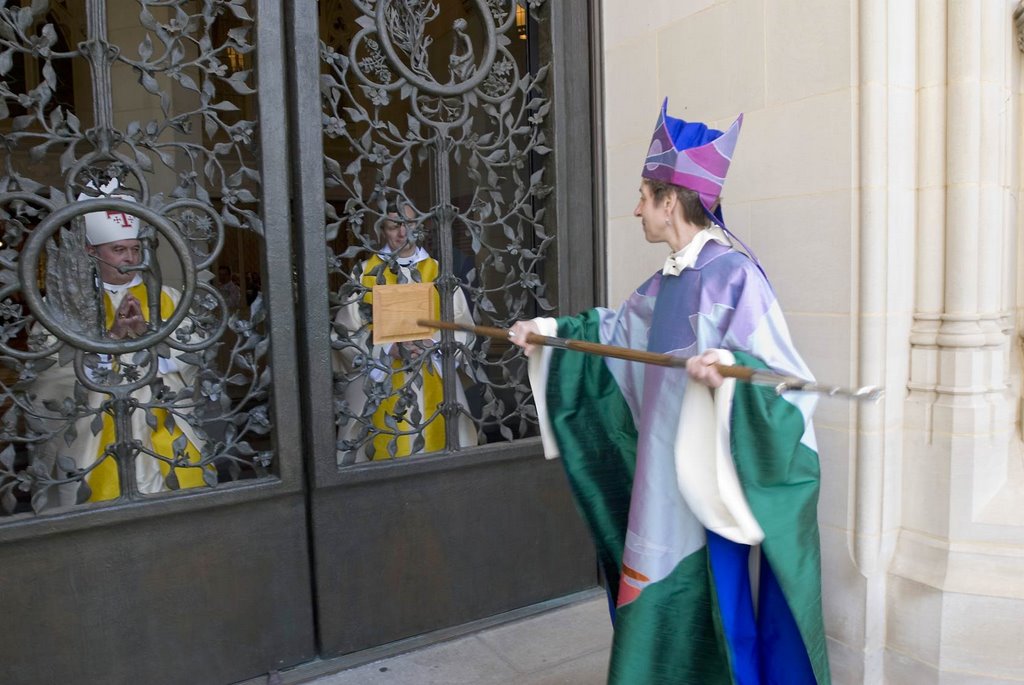

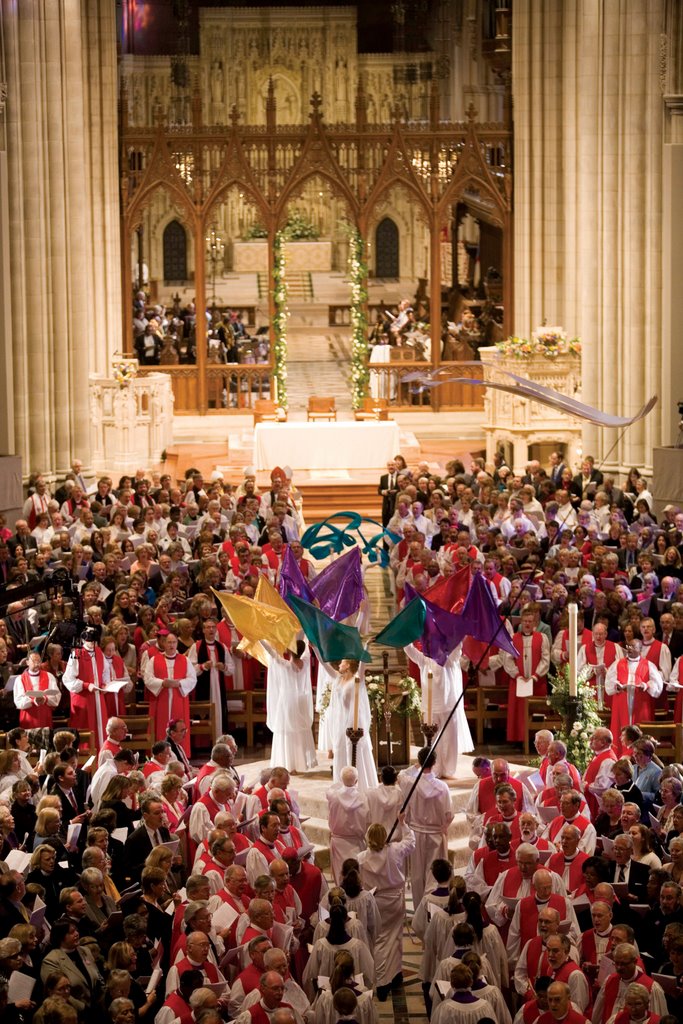
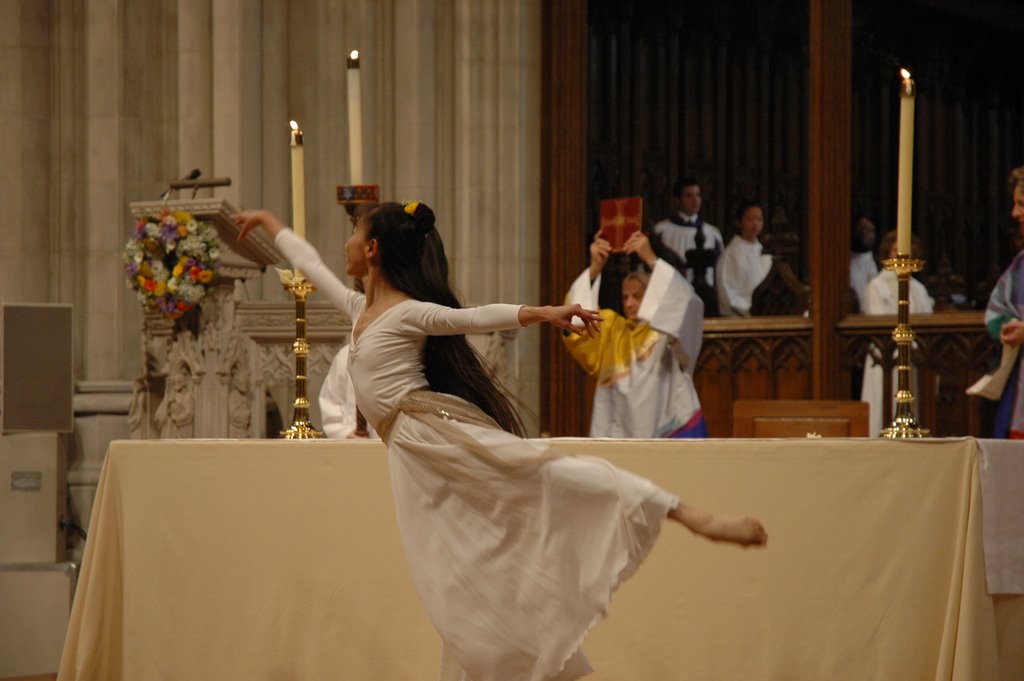
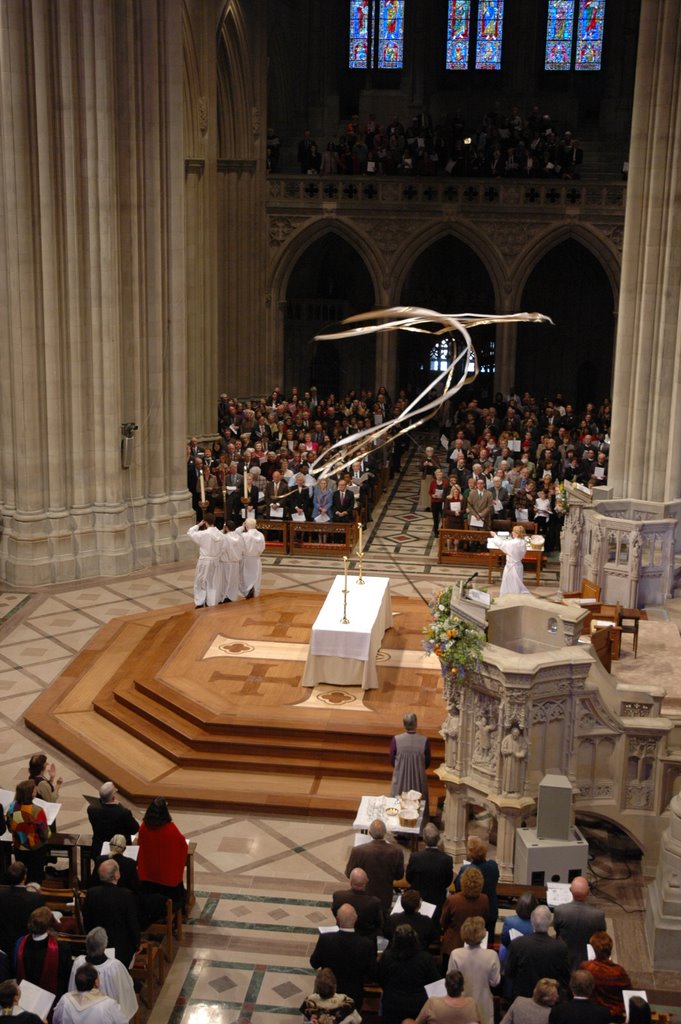

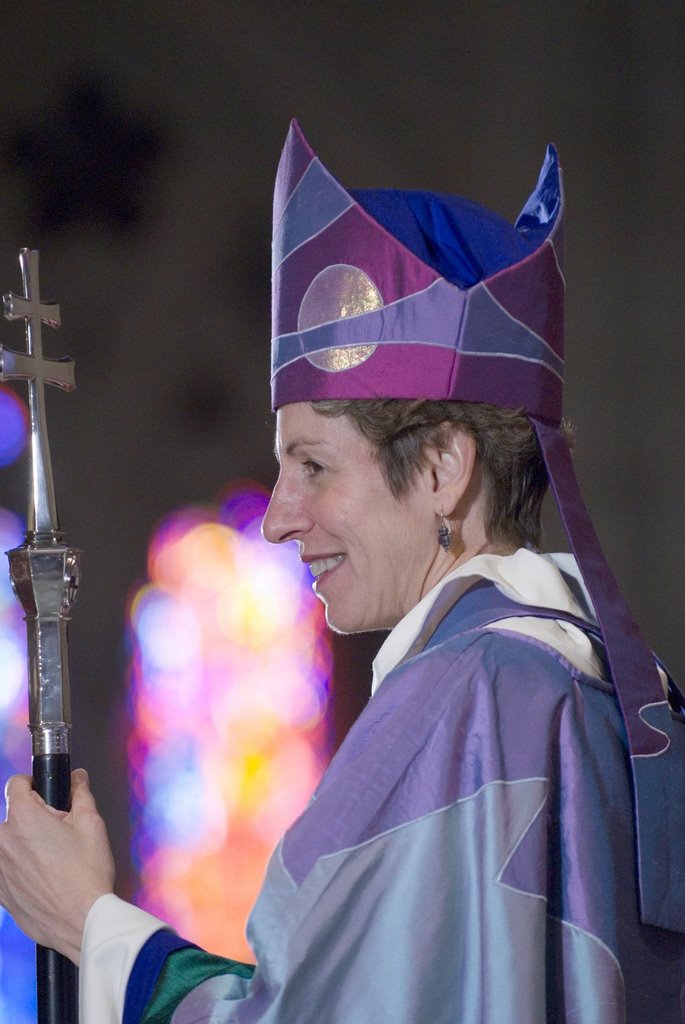
Is it alright with God?

Last week I explained to my 4-year-old grandson that I was going to be gone for four days to Washington, D.C.
“Why?” he asked.
“I’m going to the investiture of Katharine Jefferts Schori, the first woman presiding bishop and the first woman primate in the Anglican Communion.”
“Oh. Does God know?"
“Yes,” I said, “God knows. God will be there.”
“Is it alright with God?”
“Yes, it is very alright with God,” I said.
“Is it alright with you, GrandMom?” he asked.
“Yes, it is alright with me.”
“Then it’s alright with me!” he exclaimed, and leaped into my arms.
I was tickled by this exchange, as any grandmother would be. It’s nice to know he is interested in what both God and I think.
But it also grieved me that at age 4 he’s already picked up on the fact that God might have a problem with a female presiding bishop.
It’s because he lives in the Episcopal Diocese of Fort Worth. Here, even though both his parents and his grandparents think the ordination of women is one of the best things that the Episcopal Church has ever done, topped only by the election, approval and consecration of Gene Robinson, this child already has been infected by the toxic fumes of misogyny.
And why wouldn’t he? He never sees a woman presiding at the altar at our parish except for rare special occasions when we import one. He knows “Father Fred” and “Father Bill” and knows that his beloved Da is “Father Pool.” But he never sees women in clerical garb unless Deacon Janet happens to be about.
He knows that the bishop doesn’t “like” women priests because he’s heard us talk about it. Like most children, he doesn’t miss a thing when adults are in conversation.
He’s four. His brother is two.
They are why I get exasperated when people from elsewhere in the church tell me to be “patient.”
I really don’t what to one day be holding a great grandchild who asks of women in churchly authority, “Is it alright with God?”
“Why?” he asked.
“I’m going to the investiture of Katharine Jefferts Schori, the first woman presiding bishop and the first woman primate in the Anglican Communion.”
“Oh. Does God know?"
“Yes,” I said, “God knows. God will be there.”
“Is it alright with God?”
“Yes, it is very alright with God,” I said.
“Is it alright with you, GrandMom?” he asked.
“Yes, it is alright with me.”
“Then it’s alright with me!” he exclaimed, and leaped into my arms.
I was tickled by this exchange, as any grandmother would be. It’s nice to know he is interested in what both God and I think.
But it also grieved me that at age 4 he’s already picked up on the fact that God might have a problem with a female presiding bishop.
It’s because he lives in the Episcopal Diocese of Fort Worth. Here, even though both his parents and his grandparents think the ordination of women is one of the best things that the Episcopal Church has ever done, topped only by the election, approval and consecration of Gene Robinson, this child already has been infected by the toxic fumes of misogyny.
And why wouldn’t he? He never sees a woman presiding at the altar at our parish except for rare special occasions when we import one. He knows “Father Fred” and “Father Bill” and knows that his beloved Da is “Father Pool.” But he never sees women in clerical garb unless Deacon Janet happens to be about.
He knows that the bishop doesn’t “like” women priests because he’s heard us talk about it. Like most children, he doesn’t miss a thing when adults are in conversation.
He’s four. His brother is two.
They are why I get exasperated when people from elsewhere in the church tell me to be “patient.”
I really don’t what to one day be holding a great grandchild who asks of women in churchly authority, “Is it alright with God?”
Monday, November 06, 2006
Hope has come home
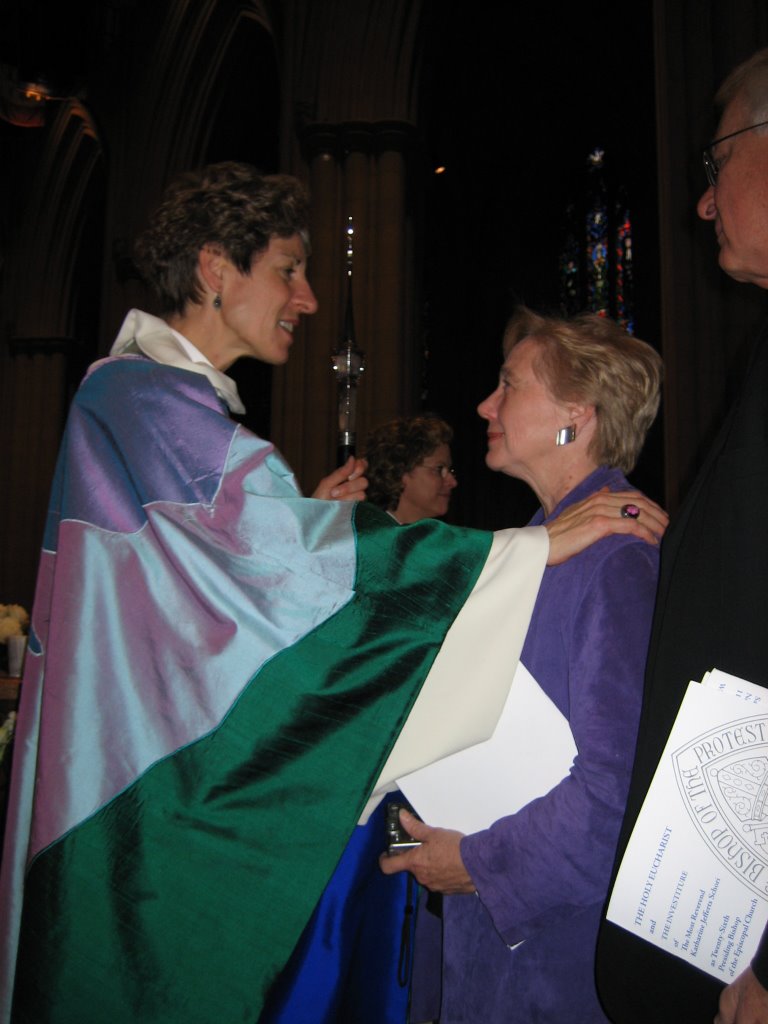
Something new took up residence in the Episcopal Church on Saturday, Nov. 4.
It is Hope, and it’s come home.
It moved in with the wind of the Holy Spirit, filling the National Cathedral with a palpable presence.
You could not only feel it, you could see it. It was in the streamers flying above our heads. It was in the dancing feet. It was in the flames on the candles and in the smoke of the smudgers.
We breathed it in and felt it homesteading our hearts.
I suspect it made its presence felt at different times for different people. For me, it was when Katharine called us all home.
I’ve felt like a homeless child in the church for a long time. Where I live, a lot of people feel that way for very different reasons. But Katharine reminded us that our natural home is our home in God. And there’s a table there we all can share. All we have to do is come to the table.
We don’t have to agree. We don’t have to judge. We don’t have to change each other’s minds. We got our seat at the table when we were baptized. When we go there, they have to take us in.
Katharine also reminded us that at our baptisms we were given a job – to not only come home, but to make a home for everyone else on earth. Everyone, not just those who agree with me or who think like I think or love like I love. Everyone.
“None of us can be fully at home, at rest, enjoying shalom, unless all the world is as well,” Katharine said.
And I thought, it’s no wonder so many in our church feel homeless, uneasy, unhappy. We’ve spent too much energy drawing lines in the sand, arguing over who’s in and who’s out, instead of working to find ways to bring us all in, warts and all.
We seem to be unable to trust God to sort it out.
It’s no wonder we are in pain. We’re wounding each other daily.
What if we stopped?
What if we stopped all the politics, dropped all the resolutions, and silenced the war-like rhetoric? What if we trusted in God to sort it out?
What if we cared more for the “other’s’ health and well being than for our own?
“The ability of any of us to enjoy shalom depends on the health of our neighbors. If some do not have the opportunity for health or wholeness, then none of us can enjoy true and perfect holiness,” Katharine said.
What keeps us from shalom? Apathy and fear. But apathy and fear cannot withstand hope -- hope in God in Jesus.
Katharine said, “If God in Jesus has made captivity captive, has taken fear hostage, it is for the liberation and flourishing of hope.”
She ended her sermon by saying, “God had spoken that dream in us, let us rejoice! Let us join the raucous throngs in creation, the sea creatures and the geological features who leap for joy at the vision of all creation restored, restored to proper relationship, to all creation come home at last. May that scripture be fulfilled in our hearing and in our doing. Shalom, my friends, shalom.” And we all responded, “Shalom.”
After the service was over, my husband and I turned to leave the balcony where we were seated, and he said, “Look!”
There on the stone floor of the north balcony was a ladybug, heading toward the stairs with the rest of us.
He picked her up and handed her to me. We smiled at one another, for we’ve known since childhood that finding a ladybug in your house is good luck. It was a silly little thing, but somehow the presence of that small creature lifted my heart even more. It was as if this small beetle represented “the raucous throngs” of all of God’s creatures present in the Cathedral.
I carried her down the stairs and across to the south door to carefully deposit her on a bush outside.
Then I walked back in to stand in line in hopes of greeting Katherine, who was standing at the font greeting everyone. And the inevitable happened -- after the euphoria of participating in such a wonderful worship service, there came the cold bite of reality. We have to return home to Fort Worth, to a very different church experience.
My heart began its familiar ache.
So I asked her for a blessing to take home.
I carry it with me now, resident in my peaceful heart, alongside hope.
It is Hope, and it’s come home.
It moved in with the wind of the Holy Spirit, filling the National Cathedral with a palpable presence.
You could not only feel it, you could see it. It was in the streamers flying above our heads. It was in the dancing feet. It was in the flames on the candles and in the smoke of the smudgers.
We breathed it in and felt it homesteading our hearts.
I suspect it made its presence felt at different times for different people. For me, it was when Katharine called us all home.
I’ve felt like a homeless child in the church for a long time. Where I live, a lot of people feel that way for very different reasons. But Katharine reminded us that our natural home is our home in God. And there’s a table there we all can share. All we have to do is come to the table.
We don’t have to agree. We don’t have to judge. We don’t have to change each other’s minds. We got our seat at the table when we were baptized. When we go there, they have to take us in.
Katharine also reminded us that at our baptisms we were given a job – to not only come home, but to make a home for everyone else on earth. Everyone, not just those who agree with me or who think like I think or love like I love. Everyone.
“None of us can be fully at home, at rest, enjoying shalom, unless all the world is as well,” Katharine said.
And I thought, it’s no wonder so many in our church feel homeless, uneasy, unhappy. We’ve spent too much energy drawing lines in the sand, arguing over who’s in and who’s out, instead of working to find ways to bring us all in, warts and all.
We seem to be unable to trust God to sort it out.
It’s no wonder we are in pain. We’re wounding each other daily.
What if we stopped?
What if we stopped all the politics, dropped all the resolutions, and silenced the war-like rhetoric? What if we trusted in God to sort it out?
What if we cared more for the “other’s’ health and well being than for our own?
“The ability of any of us to enjoy shalom depends on the health of our neighbors. If some do not have the opportunity for health or wholeness, then none of us can enjoy true and perfect holiness,” Katharine said.
What keeps us from shalom? Apathy and fear. But apathy and fear cannot withstand hope -- hope in God in Jesus.
Katharine said, “If God in Jesus has made captivity captive, has taken fear hostage, it is for the liberation and flourishing of hope.”
She ended her sermon by saying, “God had spoken that dream in us, let us rejoice! Let us join the raucous throngs in creation, the sea creatures and the geological features who leap for joy at the vision of all creation restored, restored to proper relationship, to all creation come home at last. May that scripture be fulfilled in our hearing and in our doing. Shalom, my friends, shalom.” And we all responded, “Shalom.”
After the service was over, my husband and I turned to leave the balcony where we were seated, and he said, “Look!”
There on the stone floor of the north balcony was a ladybug, heading toward the stairs with the rest of us.
He picked her up and handed her to me. We smiled at one another, for we’ve known since childhood that finding a ladybug in your house is good luck. It was a silly little thing, but somehow the presence of that small creature lifted my heart even more. It was as if this small beetle represented “the raucous throngs” of all of God’s creatures present in the Cathedral.
I carried her down the stairs and across to the south door to carefully deposit her on a bush outside.
Then I walked back in to stand in line in hopes of greeting Katherine, who was standing at the font greeting everyone. And the inevitable happened -- after the euphoria of participating in such a wonderful worship service, there came the cold bite of reality. We have to return home to Fort Worth, to a very different church experience.
My heart began its familiar ache.
So I asked her for a blessing to take home.
I carry it with me now, resident in my peaceful heart, alongside hope.
Thursday, October 19, 2006
The Thing With Feathers
Emily Dickinson wrote, “Hope is the thing with feathers.”
Yesterday, my daughter, my grandsons and I saw it, that thing with feathers.
It was whooping cranes on the wing, one of the best embodiments of hope I can think of.
Actually, we heard them before we saw them. The loud, rattling kar-r-r-o-o-o that gives them their name caught our attention immediately.
“What is that?” asked my daughter as the strange cries began filling the sky above the house.
We all looked up. There almost directly above the house were several very large white cranes circling and wheeling and crying out to one another.
“It’s the whooping cranes!” Daniella and I said simultaneously.
Both of us had just read the day before in the local paper that the whooping cranes are migrating from Canada into Texas beginning this week. The paper warned that while they would be traveling through North Texas, sightings of them would be rare. But sure enough, by the grace of God, about 25 of the between 230 and 240 whooping cranes who winter around the Aransas National Wildlife Refuge in South Texas flew right over our house.
I called out to my husband to come right now, so he could see them too. We made sure the boys could see them, and tried to explain why the grownups were so excited about “de big white birds,” as 2-year-old Gavin described them.
Why were we so excited?
Because we almost lost them forever.
All my life, I’ve read of the heroic efforts to keep the whooping cranes from extinction. When I was a child, there were less than 50 of them alive in the world.
According to the International Crane Foundation, “the only remaining natural, self-sustaining flock of whooping cranes breeds in Wood Buffalo National Park in the Northwest Territories, Canada and winters in Aransas National Wildlife Refuge (Texas).
The ICF reports that, “This flock reached a low of only sixteen birds in the winter of 1941-1942, and numbered under 35 birds over the next two decades. By 2003 there were almost 200 birds in the flock. The population migrates during both spring and fall through a relatively narrow (80-300 km wide) corridor between Aransas and Wood Buffalo.”
So you can see why state and federal wildlife officials are working overtime to alert hunters all over Texas that the five-foot-tall birds would be flying this month so DO NOT SHOOT THEM. It is a federal misdemeanor to shoot a whooping crane, even by accident. The paper said the last known shooting of a whooping crane was in November 2003 at a reservoir near Ennis.
“`The hunter, who was fined and jailed, said he thought he was aiming at a sandhill crane, which is gray, not white,’ said Tom Stehn, whooping-crane coordinator for the U.S. Fish and Wildlife Service who is stationed at Aransas.”
As I gazed up at the amazing aerial ballet going on above my house, I could only be amazed that anyone’s first reaction on seeing these birds would be to shoot them. My instinct was to drop to my knees and give thanks.
The Star-Telegram story said, “Last year, 214 whooping cranes landed at the refuge . . . With the recent death of one bird, there are a record 499 whooping cranes in North America, Stehn said. It is a "remarkable comeback" for the continent's tallest bird, whose population was 15 in 1941, he said.”
But the whooping crane still comes in third, behind the ivory-billed woodpecker and the California condor among endangered birds, according to the National Audubon Society.
According to the paper, most of the whooping cranes will move into Texas in November and will begin their 2,500-mile return to Canada between late March and early April.
I hope we are blessed to see more of these graceful vulnerable beauties.
Pray for their safe journey.
To see photos of whooping cranes go to the International Crane Foundation at
http://www.savingcranes.org/photo/free/photo_cat.cfm?cat=7
Yesterday, my daughter, my grandsons and I saw it, that thing with feathers.
It was whooping cranes on the wing, one of the best embodiments of hope I can think of.
Actually, we heard them before we saw them. The loud, rattling kar-r-r-o-o-o that gives them their name caught our attention immediately.
“What is that?” asked my daughter as the strange cries began filling the sky above the house.
We all looked up. There almost directly above the house were several very large white cranes circling and wheeling and crying out to one another.
“It’s the whooping cranes!” Daniella and I said simultaneously.
Both of us had just read the day before in the local paper that the whooping cranes are migrating from Canada into Texas beginning this week. The paper warned that while they would be traveling through North Texas, sightings of them would be rare. But sure enough, by the grace of God, about 25 of the between 230 and 240 whooping cranes who winter around the Aransas National Wildlife Refuge in South Texas flew right over our house.
I called out to my husband to come right now, so he could see them too. We made sure the boys could see them, and tried to explain why the grownups were so excited about “de big white birds,” as 2-year-old Gavin described them.
Why were we so excited?
Because we almost lost them forever.
All my life, I’ve read of the heroic efforts to keep the whooping cranes from extinction. When I was a child, there were less than 50 of them alive in the world.
According to the International Crane Foundation, “the only remaining natural, self-sustaining flock of whooping cranes breeds in Wood Buffalo National Park in the Northwest Territories, Canada and winters in Aransas National Wildlife Refuge (Texas).
The ICF reports that, “This flock reached a low of only sixteen birds in the winter of 1941-1942, and numbered under 35 birds over the next two decades. By 2003 there were almost 200 birds in the flock. The population migrates during both spring and fall through a relatively narrow (80-300 km wide) corridor between Aransas and Wood Buffalo.”
So you can see why state and federal wildlife officials are working overtime to alert hunters all over Texas that the five-foot-tall birds would be flying this month so DO NOT SHOOT THEM. It is a federal misdemeanor to shoot a whooping crane, even by accident. The paper said the last known shooting of a whooping crane was in November 2003 at a reservoir near Ennis.
“`The hunter, who was fined and jailed, said he thought he was aiming at a sandhill crane, which is gray, not white,’ said Tom Stehn, whooping-crane coordinator for the U.S. Fish and Wildlife Service who is stationed at Aransas.”
As I gazed up at the amazing aerial ballet going on above my house, I could only be amazed that anyone’s first reaction on seeing these birds would be to shoot them. My instinct was to drop to my knees and give thanks.
The Star-Telegram story said, “Last year, 214 whooping cranes landed at the refuge . . . With the recent death of one bird, there are a record 499 whooping cranes in North America, Stehn said. It is a "remarkable comeback" for the continent's tallest bird, whose population was 15 in 1941, he said.”
But the whooping crane still comes in third, behind the ivory-billed woodpecker and the California condor among endangered birds, according to the National Audubon Society.
According to the paper, most of the whooping cranes will move into Texas in November and will begin their 2,500-mile return to Canada between late March and early April.
I hope we are blessed to see more of these graceful vulnerable beauties.
Pray for their safe journey.
To see photos of whooping cranes go to the International Crane Foundation at
http://www.savingcranes.org/photo/free/photo_cat.cfm?cat=7
Monday, October 16, 2006
Complicit in Abuse
The thing that has helped me most in understanding what is happening in the Episcopal Church and the Anglican Communion is writing about domestic violence as a reporter since the early 1970s.
In those days, police referred to its victims as “battered women.” Most district attorneys’ offices would prosecute the batterer only if the wife agreed to divorce him.
That is, if the police even bothered to arrest him. Usually one officer would walk the man around the block to “cool him off” while the other office stayed with the woman to find out what she did “to set him off” and to urge her not to do that again.
After all, if she’d just “act right,” everything would be OK.
Any of this sound familiar?
You can see why many women’s advocates felt it was important to do some educating of the police, DAs, and the public. That’s why October is Domestic Violence Awareness Month. In some places it’s called Domestic Violence Prevention Month.
In either case, the drive is to encourage people to get involved in domestic violence prevention efforts and to intervene if they know someone in an abusive relationship.
Episcopalians should pay close attention to these education efforts, because our church is in an abusive relationship.
Here are the warning signs:
· Abusers use emotional abuse. They put you down in many ways, make you feel bad about yourself, call you names, try to make you think you’re “crazy, play mind games, humiliate you and make you feel guilty.
· Abusers use coercion and threats. They make or carry out threats to do something to hurt you. They threaten to leave you, to commit suicide or to report you to authorities without cause. They make you drop charges. They make you do illegal things.
· Abusers use economic abuse. They take your money. They refuse to give you money. They prevent you from getting a job. They make you ask for money. They won’t let you know about the family money or let you have access to the family income.
· Abusers use gender privilege. They treat you like a servant. They make all the big decisions. They act like “master of the castle.” They define “men’s” and “women’s” roles.
· Abusers use intimidation. They make you afraid by using looks, gestures and actions. They smash things. They abuse pets. They display weapons.
· Abusers use the children. They make you feel guilty about the children. They use the children to relay messages. They use visitation to harass you. They threaten to take the children away from you.
· Abusers use isolation. They control what you do, whom you see and talk to, what you read and where you go. They limit your outside involvement. They use jealousy to justify actions.
· Abusers minimize, deny, blame. They make light of the abuse. They don’t take your concern seriously. They say the abuse didn’t happen. They shift responsibility for abusive behavior to you.
From the Texas Council on Family Violence http://www.tcfv.org/
For national information, go to Family Violence Prevention Fund at http://www.endabuse.org/
This list could well be a strategy memo for those conservatives who are determined to wreck the Episcopal Church and/or to replace it with their own “purified” NeoPuritan version.
One can go down the list and check it off.
Uses emotional abuse and calls you names? Try “pagan” and “revisionist” and “heretic.”
Tries to make you feel guilty? Try claiming that Christians are being killed in majority Muslim countries because TEC elected and confirmed an honestly gay man.
Plays mind games? Try claiming that Lambeth resolutions have the power of laws, or that TEC has been “kicked out of” the Anglican Communion, or that the Windsor Report is some kind of judgment from on high against us.
Uses coercion and threats? Try threats of leaving, again and again and again and again.
Uses economic abuse. Try withholding money from the national church.
Uses gender privilege. Surely I don’t have to explain this one.
You do it. Go down the list and see what you come up with.
So. Once it is determined someone is in an abusive relationship, what happens next?
The number one thing to do is GET AWAY FROM YOUR ABUSER.
What part of this does our church leadership not understand?
Those of us in places like Fort Worth really want to know. For at least fifteen years those of us in the Diocese of Fort Worth who support the ordination of women and the full inclusion of LGBT people in the life and work of the church have been trying to get some help, or least encouragement, from the national church as our diocesan leadership moved year after year to isolate and separate us more and more from the national church. The Episcopal Women's Caucus, Integrity and Claiming the Blessing are the only organizations in the church who responded to our cries for help. Only now that the same issues we’ve been struggling with here are threatening the larger church is the national church finally paying attention.
Reminds me of the mousetrap story:
A mouse looked through the crack in the wall to see the farmer and his wife opening a package containing a mousetrap. Rushing to the farmyard, the worried mouse proclaimed the warning.
"There is a mousetrap in the house! There is a mousetrap in the house!"
The chicken clucked and said, "Mr. Mouse, I can tell this is a grave concern to you but it is of no consequence to me. I cannot be bothered by it."
The pig sympathized, but said, "I am so very sorry, Mr. Mouse, but there is nothing I can do about it but pray. Be assured you are in my prayers."
The cow said, "Wow, Mr. Mouse. I'm sorry for you, but it's no skin off my nose."
So, the mouse sadly returned to the house to face the farmer's mousetrap-- alone.
That very night the sound of a mousetrap catching its prey was heard throughout the house. The farmer's wife rushed to see what was caught. In the darkness, she did not see it was a venomous snake whose tail the trap had caught.
The snake bit the farmer's wife. The farmer rushed her to the hospital and she returned home with a fever. Everyone knows you treat a fever with fresh chicken soup, so the farmer took his hatchet to the farmyard for the soup's main ingredient.
But his wife's sickness continued, so friends and neighbors came to sit with her around the clock. To feed them, the farmer butchered the pig.
Then the farmer's wife died. So many people came for her funeral, the farmer had the cow slaughtered to provide enough meat for all of them.
The mouse looked upon it all from his crack in the wall with great sadness.
St. Paul could have told this story. It’s about what hurts one part of the body hurts us all. When one of us is threatened, we are all at risk.
It’s time to name the abuse, use the laws to contain or punish the abusers, and to help those suffering under the abuse.
To do less is to become complicit in your own abuse.
In those days, police referred to its victims as “battered women.” Most district attorneys’ offices would prosecute the batterer only if the wife agreed to divorce him.
That is, if the police even bothered to arrest him. Usually one officer would walk the man around the block to “cool him off” while the other office stayed with the woman to find out what she did “to set him off” and to urge her not to do that again.
After all, if she’d just “act right,” everything would be OK.
Any of this sound familiar?
You can see why many women’s advocates felt it was important to do some educating of the police, DAs, and the public. That’s why October is Domestic Violence Awareness Month. In some places it’s called Domestic Violence Prevention Month.
In either case, the drive is to encourage people to get involved in domestic violence prevention efforts and to intervene if they know someone in an abusive relationship.
Episcopalians should pay close attention to these education efforts, because our church is in an abusive relationship.
Here are the warning signs:
· Abusers use emotional abuse. They put you down in many ways, make you feel bad about yourself, call you names, try to make you think you’re “crazy, play mind games, humiliate you and make you feel guilty.
· Abusers use coercion and threats. They make or carry out threats to do something to hurt you. They threaten to leave you, to commit suicide or to report you to authorities without cause. They make you drop charges. They make you do illegal things.
· Abusers use economic abuse. They take your money. They refuse to give you money. They prevent you from getting a job. They make you ask for money. They won’t let you know about the family money or let you have access to the family income.
· Abusers use gender privilege. They treat you like a servant. They make all the big decisions. They act like “master of the castle.” They define “men’s” and “women’s” roles.
· Abusers use intimidation. They make you afraid by using looks, gestures and actions. They smash things. They abuse pets. They display weapons.
· Abusers use the children. They make you feel guilty about the children. They use the children to relay messages. They use visitation to harass you. They threaten to take the children away from you.
· Abusers use isolation. They control what you do, whom you see and talk to, what you read and where you go. They limit your outside involvement. They use jealousy to justify actions.
· Abusers minimize, deny, blame. They make light of the abuse. They don’t take your concern seriously. They say the abuse didn’t happen. They shift responsibility for abusive behavior to you.
From the Texas Council on Family Violence http://www.tcfv.org/
For national information, go to Family Violence Prevention Fund at http://www.endabuse.org/
This list could well be a strategy memo for those conservatives who are determined to wreck the Episcopal Church and/or to replace it with their own “purified” NeoPuritan version.
One can go down the list and check it off.
Uses emotional abuse and calls you names? Try “pagan” and “revisionist” and “heretic.”
Tries to make you feel guilty? Try claiming that Christians are being killed in majority Muslim countries because TEC elected and confirmed an honestly gay man.
Plays mind games? Try claiming that Lambeth resolutions have the power of laws, or that TEC has been “kicked out of” the Anglican Communion, or that the Windsor Report is some kind of judgment from on high against us.
Uses coercion and threats? Try threats of leaving, again and again and again and again.
Uses economic abuse. Try withholding money from the national church.
Uses gender privilege. Surely I don’t have to explain this one.
You do it. Go down the list and see what you come up with.
So. Once it is determined someone is in an abusive relationship, what happens next?
The number one thing to do is GET AWAY FROM YOUR ABUSER.
Trying to placate or appease abusers never works.
What does work is separating yourself from the abuser and then using the rule of law to remove him from a position where he can abuse you, to keep him from abusing you again, and to keep safe others being hurt.
What part of this does our church leadership not understand?
Those of us in places like Fort Worth really want to know. For at least fifteen years those of us in the Diocese of Fort Worth who support the ordination of women and the full inclusion of LGBT people in the life and work of the church have been trying to get some help, or least encouragement, from the national church as our diocesan leadership moved year after year to isolate and separate us more and more from the national church. The Episcopal Women's Caucus, Integrity and Claiming the Blessing are the only organizations in the church who responded to our cries for help. Only now that the same issues we’ve been struggling with here are threatening the larger church is the national church finally paying attention.
Reminds me of the mousetrap story:
A mouse looked through the crack in the wall to see the farmer and his wife opening a package containing a mousetrap. Rushing to the farmyard, the worried mouse proclaimed the warning.
"There is a mousetrap in the house! There is a mousetrap in the house!"
The chicken clucked and said, "Mr. Mouse, I can tell this is a grave concern to you but it is of no consequence to me. I cannot be bothered by it."
The pig sympathized, but said, "I am so very sorry, Mr. Mouse, but there is nothing I can do about it but pray. Be assured you are in my prayers."
The cow said, "Wow, Mr. Mouse. I'm sorry for you, but it's no skin off my nose."
So, the mouse sadly returned to the house to face the farmer's mousetrap-- alone.
That very night the sound of a mousetrap catching its prey was heard throughout the house. The farmer's wife rushed to see what was caught. In the darkness, she did not see it was a venomous snake whose tail the trap had caught.
The snake bit the farmer's wife. The farmer rushed her to the hospital and she returned home with a fever. Everyone knows you treat a fever with fresh chicken soup, so the farmer took his hatchet to the farmyard for the soup's main ingredient.
But his wife's sickness continued, so friends and neighbors came to sit with her around the clock. To feed them, the farmer butchered the pig.
Then the farmer's wife died. So many people came for her funeral, the farmer had the cow slaughtered to provide enough meat for all of them.
The mouse looked upon it all from his crack in the wall with great sadness.
St. Paul could have told this story. It’s about what hurts one part of the body hurts us all. When one of us is threatened, we are all at risk.
It’s time to name the abuse, use the laws to contain or punish the abusers, and to help those suffering under the abuse.
To do less is to become complicit in your own abuse.
Thursday, October 12, 2006
All Will Be Well
SPEECH TO DALLAS VIA MEDIA
OCT. 1, 2006
First of all, I want it on record that I’m not here tonight to give THE answer to the problems plaguing the Anglican Communion.
But as a long time observer of secular and churchly politics, what I CAN do is offer some information and analysis.
Much of this will be bullet points, so I can cover as much information as possible in the time we have.
First, the Windsor Report:
Our church is now moving through what many describe as a time of turmoil. There are those who are working hard to keep things as stirred up as possible in the wake of the actions of General Convention 2003. One tool they are using to great effect is the Windsor Report. They make loud and repeated demands that The Episcopal Church “submit” to it and use disinformation to stir up as much anxiety as possible.
So information is our best weapon against the fog of words being put out by those threatening schism.
Here are facts:
* The Anglican Communion is not a church. It is a fellowship of highly autonomous provinces.
* The Archbishop of Canterbury has no power to do anything or order any action taken in any province of the Anglican Communion except the Church of England.
*Lambeth has no legislative power. In “The Study of Anglicanism,” John Booty and Stephen Sykes wrote, “The Lambeth Conference has remained a deliberating body convened solely at the invitation of the Archbishop of Canterbury. Whatever the respect according to its deliberations, it has no canonical or constitutional status.”
* Lambeth degrees are not only not binding, they are reversable. In 1920, Lambeth issued a resolution strongly forbidding birth control. At its very next meeting in 1930, Lambeth reversed itself. In 1888, Lambeth held that polygamists could not be received for baptism until they became monogamous. In 1988 Lambeth said that polygamists could be baptized but could not take another wife as long as any of their wives were living -- offering pastoral means to resolve the polygamy issue in those Provinces whose cultures condone it.
* The Archbishop of Canterbury, the Anglican Consultative Council, the Lambeth Conference and the Primates Meeting were first grouped in the 1997 Virginia Report which preceded Lambeth 1998. In that report these entities were called “World-Wide Instruments of Communion” in a chapter discussing ideas that the bishops at Lambeth might choose to explore. The authors of the Windsor Report introduced the term “Instruments of Unity” for the first time in 2004.
* The Primates have met regularly only since 1979. At that first meeting, the Primates themselves defined the meeting’s purpose as “not being a higher synod but a clearing house for ideas and experience through free expression, the fruits of which the Primates might convey to their churches.”
* Who decides who is a member of the Anglican Communion and who is not? We might look for an answer in the Canons of the Church of England. Rule 54(5) of the Church Representative Rules provides that “if any question arises whether a Church is in communion with the Church of England, it shall be conclusively determined for the purposes of these rules by the Archbishops of Canterbury and York.”
Archbishop Robin Eames, Chairman of the Lambeth Commission which produced the Windsor Report, says in his introduction:
"This report is not a judgment. It is part of a process. It is part of a
pilgrimage toward healing and reconciliation."
Let’s repeat that – it’s a report. It’s not a judgment. It’s not legislation. It’s not Holy Writ. You can’t submit to a report.
[Note: Since this speech was given, The Most Reverend Barry Morgan, “Archbishop of Wales and one of the drafters of the Windsor Report said in his September Presidential Address, "... we did not have in mind a covenant that was prescriptive and detailed and intrusive. What we did have in mind was what ECUSA did at its convention in July."]
Now for the Windsor Report itself. This Report that is being held over the head of The Episcopal Church like some flaming sword of a vengeful god is a very flawed document that focuses so tightly on Institutional Preservation that I fear it leaves no room for the workings of the Holy Spirit.
It does recognize that The Episcopal Church and the Canadian Church acted within the bounds of their Canons and Constitution, but after that, it goes downhill.
The Windsor Report – according to its own creators – was supposed to start a discussion, not end one. But it did so in such a clumsy ham fisted way that it short-circuited the discussion it hoped for.
Among its deficiencies is its laughably inaccurate account of the history of the ordination of women and its reception in the Communion. It also skates very lightly indeed over the way the Communion historically has dealt with anyone other than white males.
It proposes a completely un-Anglican confessional document and calls for a highly centralized non-elected authority of clerics to run the Anglican Communion. It also calls for a convoluted process by which all Episcopal elections anywhere – and one assumes appointments in the places where bishops are appointed, not elected – would have to be approved by the entire Communion, as would other controversial matters. One assumes this unelected Curia would get to decide what is “controversial” and what it not.
And, as we all know -- it calls on The Episcopal Church to impose indefinite moratoria on the episcopal election of any more gay people living in committed relationships and on same-sex unions, quite offensively placing the entire burden on one small of group of our sisters and brothers in Christ.
So deficient is this document that at their first meeting after it was issued, the Primates dismissed it as “inadequate” as did all – all – of the conservative groups in The Episcopal Church.
It was only after they realized that the Windsor Report was all they were going to get out of Lambeth that they began to represent it as a legislative judgment passed on The Episcopal Church by the rest of the Communion.
But no matter how much sturm und drang they keep raising, and no matter how many meetings various groups of bishops may have, the General Convention is the only body in The Episcopal Church with the authority to respond to the Windsor Report.
Bonnie Anderson, the new President of the House of Deputies points out in her recent letter in response to the Camp Allen meeting and the Kigali Statement that “The Windsor Report was issued as one part of a process. The responsibility for the response to the Windsor Report belongs to the General Convention of the Episcopal Church, a bicameral legislature with representation from lay and clergy as well as bishops. At the 75th General Convention, our response was made. Our bishops certainly can and do meet together. However, when decisions affecting the whole Episcopal Church are made, representatives of the whole Episcopal Church need to be present for the conversations as well as the possible decision making.”
The Windsor Report was written to the whole communion, not just The Episcopal Church. Its purpose was not to explore the subject of homosexuality, but to explore ways to remain in communion with one another while holding serious disagreements.
To this end, it strongly urged bishops to stop interfering in provinces and dioceses other than their own.
It also repeated the urgings of Lambeth Conferences of 1978, 1988 and 1998 for the entire communion to engage in a listening process in which they would listen to the experience of their gay and lesbian brothers and sisters in Christ.
Out of that list, the Episcopal Church has done more to participate in – or if you prefer, to “comply” with -- the Windsor Process than any other province.
So when bishops start calling themselves “”Windsor compliant” because they forbid same sex blessings and have condemned the consecration of the Bishop of New Hampshire, one might ask about the listening process in their dioceses and the letters they have written to admonish fellow bishops who have continued to make extra-territorial incursions – such as ordaining a priest of the Episcopal Church a bishop in the Church of Nigeria with the mandate to minister to people in The Episcopal Church.
Unless they have done all these things, they are not “Windsor compliant.” Our bishops are not “Windsor compliant.” They are “partially Windsor compliant.” You and I live in “partially Windsor compliant’ dioceses.
Events began overtaking the WR within weeks of it being issued. Many Primates ignored its request that Primates not interfere with the business of Provinces not their own. Meetings in Cairo and Pittsburgh made it clear that many already had decided to split from The Episcopal Church no matter what General Convention did in Columbus.
So it was no surprise that many began to fling accusations that General Convention “thumbed its nose” at the Windsor Report even before Convention was over. This is not helpful. Such rhetoric insults the hard thoughtful and prayerful work done by bishops, priests and deputies on the resolutions dealing with the report. Yes, GC 2006 didn't do absolutely everything that the WR suggested, but as several have noted, neither has anyone else. As many have pointed out, we're more “Windsor Compliant” than most.
The last minute passage of B033 was handled badly, and many people felt spiritually beat up, not only by the passage of the resolution, but by the manner it which it was presented and the pressure put on both houses by the presiding bishop and the presiding bishop elect.
And within minutes of its passage, conservatives were issuing loud complaints that it was not enough to satisfy them.
I believe the most faithful want to work this out. But I also believe the reason so many Episcopalians are instinctively uneasy with The Windsor Report is that it is a very institutional-centered document reflecting the highly hierarchical nature of some Provinces of our Communion. For instance, it has taken more than three years for much of the Communion to "get" that we elect bishops, we don't appoint them. This is the kind of misunderstanding that has caused the Scottish Episcopal Church and New Zealand and Australia to share our skepticism.
Another reason for this unease for us, I believe, is our Baptismal Covenant, which since 1979 has become part of our spiritual DNA.
As a friend of mine pointed out, unlike the very hierarchical Windsor Report, the Baptismal Covenant is crafted to reflect a pre-hierarchical Church: the Church of Paul, where we have different functions rather than more or less power.
That's a very significant distinction.
The Windsor Report is all about the institutional church, not about the Gospel. It’s good to remember that Jesus never envisioned a "church" at all: he preached exclusively about the Kingdom of God.
So when people say – as many have in the wake of General Convention – that “the Baptismal Covenant trumps Windsor" they are saying that "Jesus and Paul trump religious institutions".
Another reason for our unease is that the recommendations of the WR are being so obviously selectively accepted and selectively "enforced."
Which brings me to the impact the Windsor Report has had on the leadership of Rowan Williams.
The Archbishop of Canterbury apparently has no problem with everyone being “partially Windsor compliant.” Michael Russell has pointed out that while Rowan has made some mild statements about stopping foreign incursions by some bishops in Africa, he has never strongly encouraged them to stop the incursions nor has he even suggested they initiate a meaningful listening process. Williams’ worst sin of omission is his shameful failure to challenge the actions of the Church of Nigeria in its vociferous support of the criminalization of homosexuality in Nigeria – laws that can lead to the imprisonment and death of gay and lesbian people, as well as the imprisonment of anyone who speaks out in their behalf!
All of his admonitions have been aimed at The Episcopal Church, and to a lesser degree, The Anglican Church in Canada. But if anyone has thumbed its nose at the Windsor Report, it is those in the Anglican Communion who have ignored the provisions of the report aimed at them. The Episcopal Church is at least struggling with it.
What the Archbishop of Canterbury has tried to do is articulate in his indirect oh-so-British way is that he has no authority to make anyone do anything outside the Church of England, so he’d like us to work this out amongst ourselves.
Because no matter how much some Primates may act like it, there is no actual structure to enforce decisions made by any extra-national group in the World Wide Anglican Communion.
In the end, the integrity of The Windsor Report has been lost because the Archbishop of Canterbury has held us to one standard and the rest of the Anglican Communion to another.
Now to CAMP ALLEN.
I think there are two reasons why the announcement of the meeting at Camp Allen raised concerns.
One was that it was bishops only who were meeting, and Episcopalians always get nervous when bishops are in a room by themselves. It increases the chances of bishops behaving badly.
And two, the admissions test. Bishops were required to accept as doctrinal and authoritative not only the recommendations of The Windsor Report but also the actions of Lambeth. Michael Russell reminded us that physics and other sciences teach us that outcomes are often quite controlled by initial conditions.
The truth is, as Ann Fontaine pointed out on the HOB/D list, Camp Allen was just a group of 21 bishops who have an opinion. Bishops are welcome to meet and to lobby the church in whatever direction they wish. She pointed out that that is what those who have worked for full inclusion of women in all orders of ministry and gays' and lesbians' full participation in the church have done. Their view has prevailed within the rules of order and the Constitution and Canons of The Episcopal Church. That has outraged many who were used to having things done “their’ way.
Camp Allen looked to many like yet another attempt at an end run to achieve goals they couldn’t get at General Convention. But there is no "body" that can enforce what they want except General Convention.
Jim Stockton of Austin figured out that, with five additions, these were very same bishops who signed off in April of 2005 on the urgent plea to the ABC, thereby contradicting their participation less than a month earlier in the House of Bishops Covenant Statement.
Two of the new additions were new bishops following in their predecessors' footsteps: Lillibridge following Folts and Love following Herzog. Keith ackerman of Quincy was no surprise. The only two ‘new” names since April 2005 are Mark MacDonald of Alaska and Geralyn Wolf of Rhode Island. And so far, with the exception of Ackerman, these names merely represent the bishops, not the dioceses. This distinction is very likely to be addressed at upcoming diocesan councils and conventions.
I fear that instead of being reconciling, this was a meeting aimed at further dividing The Episcopal Church. More than one person pointed out that the most shameful part of the Camp Allen statement is that it includes no acknowledgement of the responsibility of the African bishops to respect the election of Katharine Jefferts Schori. The lack of an affirmation of her election by the non-Network bishops present is inexcusable.
Jim Stockton's analysis of The Camp Allen meeting pointed out that it also had to affect the meeting the ++PB and ++PB elect had in New York. While they are working to come up with a pastoral solution for those distressed by Katharine’s election, the Camp Allen meeting was working to divide the church into Windsor compliant and Windsor non-compliant camps.
Moreover, Camp Allen was gathered around an agenda that dismisses the obligation of dioceses and their bishops to abide by the Constitution and Canons of the Church.
One observer described it as “an attempt to construct an alliance comprised of those bishops fiercely committed to a puritan revision of the Episcopal Church with those bishops who have recognized their own misgivings around certain policies of the Church and who are willing to entertain non-canonical means of challenging them.”
After all, claiming the right to seek direct relationships with the Archbishop of Canterbury and the Anglican Primates, effectively inviting the ABC to violate jurisdictional boundaries, is in direct contradiction of the recommendations the WR.
It has been pointed out that trying to create a new category of bishops entitled 'Windsor Compliant,' and to foment non-compliance to our Constitution and Canons is to foment also non-compliance with the spirit and letter of the ever-exalted Windsor Report. “The only compliance left is compliance to one's own prejudices.”
Here is what Presiding Bishop Frank Griswold has to say about the Camp Allen meeting:
“With regard to the gathering in Texas, advance and follow-up information about this meeting suggest an involvement by the Archbishop of Canterbury. It is important for you to know that the Texas meeting was in no way held at the Archbishop's initiative nor was it planned in collaboration with him. The two bishops from the Church of England did not attend as delegates of the Archbishop, nor were they empowered to speak on his behalf except to give the message that "the bishops meeting are bishops of the Catholic Church in the Anglican Communion."
“The letter from Texas said it is the clear sense of the signers that "the General Convention of 2006 did not adequately respond to the request made of the Episcopal Church by the Communion through the Windsor Report and the Primates at Dromantine." It says that this view is "consistent with the Archbishop of Canterbury's Holy Cross Day letter to the Primates." Given the very nuanced and cautious way in which the Archbishop expresses himself, I think it is important here to refer back to that letter and what Rowan actually said, and I quote: "It is also clear that the Episcopal Church has taken very seriously the recommendations of the Windsor Report; but the resolutions of General Convention still represent what can only be called a mixed response to the Dromantine requests. The advisory group has spent much time in examining these resolutions in great detail, and its sense is that although some aspects of these requests have been fully dealt with, there remain some that have not."
“I note here that Archbishop Robin Eames, Chairman of the Lambeth Commission which produced the Windsor Report, says in his introduction: "This report is not a judgment. It is part of a process. It is part of a pilgrimage toward healing and reconciliation." As such, I believe the "Windsor process" is a process of mutual growth which calls for patience, mutual understanding and generosity of spirit rather than stark submission.
“It also needs to be said that the assessment of the responses of the Episcopal Church to the Windsor process is not the responsibility of self-chosen groups within the Communion. At the April 2006 meeting of the Joint Standing Committee of the primates and the Anglican Consultative Council a small working group drawn from different parts of the Communion was identified to consider the actions and decisions of our General Convention. They will communicate to both the Joint Standing Committee and then the Primates Meeting in February. The Archbishop has repeatedly underscored the need to allow this process to unfold.
“The General Convention in Resolution A165 affirmed our commitment to the Windsor process. From my perspective, being faithful to the Windsor process – and the Covenant process which is integral to it – calls for patience and rules out actions which would preempt their orderly unfolding. In my view, portions of the Kigali statement that take issue with the actions of the Episcopal Church in advance of hearing from the advisory group, and before the Covenant has an opportunity to be developed, are inconsistent with the Windsor process, as are continuing incursions of bishops from other provinces into our dioceses. Patience and respect for one another and our provincial structures are required on the part of us all.”
And that brings us to the KIGALI STATEMENT
Perhaps the best response to the meeting in Kigali came from Bonnie Anderson, the president of the House of Deputies.
She wrote: “The Global South Primates who recently met at Kigali have a right to meet, but
no right to make decisions for the Anglican Communion. They have expressed concern about the perceived unilateral actions taken the General Convention of the Episcopal Church in 2003. However, their statement is truly a unilateral act.”
She points out that, “In their statement they distance themselves from Bishop Jefferts Schori for holding views that are similar to those held by Bishop Griswold, Bishop Browning before and other Primates currently. There is nothing unique in her views. What is unique is her gender in the circle of primates. That seems to be their biggest objection. I note with sadness that the Kigali communiqué does not extend the courtesy of referring to Bishop Jefferts Schori as a bishop, where everyone else is referred to with titles. It adds a low note that is not worthy of the faith espoused in the document.”
Here it is important to point out that questions are emerging as to just how many bishops who were at the meeting in Kigali actually signed on to this statement, or indeed, even knew about it. Anglican Church of Southern Africa Archbishop Ndungane has said that while he and Canon Livingstone Ngewu were present in Kigali, neither of them was made aware even of the possibility of a communiqué in the name of the Primates of the Global South, prior to its release. That was followed by a September 28 statement from the Episcopal Church in the Philippines (ECP) which clarified that its Prime Bishop, the Most Rev. Ignacio C. Soliba, "did not attend the meeting and was not a signatory to the so-called Kigali Communiqué." There are 38 Provinces in the Anglican Communion. So now we’re down from 20 primates to 18. That’s not even half of the provinces in the Communion, must less a majority. The Philippine statement also offered greetings on behalf of the province to Presiding Bishop-elect Katharine Jefferts Schori and welcomed her election. "The Episcopal Church in the Philippines will extend an invitation for her to visit the Philippines in early 2008 for the renewal of our historical ties and covenant relationship," the statement said.
However many Primates really signed on to the statement and the question of just how much of the Communion really is in tune with the statement, it DOES raise concerns.
This is interference in the Episcopal Church's affairs of the most outrageous sort - essentially this communiqué asks for an alternate Primate to be sent from the Episcopal Church.
The Communique also proposes active planning for a structure that they clearly intend to be accepted as the official Anglican province representing the USA.
The Episcopal Majority spoke for many of us when they said that most of us were – and still are -- hoping that the various actors within Anglicanism were in good faith looking for a solution to our present difficulties. If the meeting in Kigali doesn’t obliterate that hope, it certainly dims it. The meeting revealed a large group within the Church determined to mold the Communion in their neo-Puritan image.
Forget the Windsor Process. The Rt. Reverend Peter Akinola and his Global South buddies want to establish a new Anglicanism.
The Episcopal Majority blogsite has very clearly laid out how it looks:
They plan to soon produce an Anglican Covenant, their definitive statement of what Anglicanism is.
They were at work even before the official process, prompted by the Archbishop of Canterbury, began. Indeed, their document is almost finished. It certainly will adhere strictly to their stated views on homosexuality – which is "an evil" and a "perversion," according to their statements. Further, they will forbid the ordination of homosexuals to the diaconate and clergy, even though the Windsor Report never suggested they should be.
They will submit this material to the official Anglican Covenant Committee chaired by the Rt. Rev. Drexel Gomez, an outspoken supporter of an Anglican realignment who opposes the inclusion of gay men and lesbians in the Church.
The communiqué also discussed alternative primatial oversight. According to the process currently in place, these matters and others dealing with similar conflicts were to be referred to the Panel of Reference set up by the Archbishop of Canterbury. According to the communiqué this matter will now be taken up by "the Global South Steering Committee" to "develop a proposal identifying the ways by which the requested Primatial oversight can be adequately provided." The Committee will "meet with the leadership of the dioceses requesting Alternative Primatial Oversight, in consultation with the Archbishop of Canterbury, the Network and the ‘Windsor Dioceses’."
Why are they doing this? Because of the "slow response from the Panel of Reference." Not only have they dismissed the Archbishop of Canterbury’s panel, they have decided the Archbishop himself is now one of many to be consulted in the matter of primatial oversight.
The communiqué then speaks of their intent to set up, under their sole guidance, a parallel ecclesiastical structure in America:
"We are convinced that the time has now come to take initial steps towards the formation of what will be recognized as a separate ecclesiastical structure of the Anglican Communion in the USA. We have asked the Global South Steering Committee to develop such a proposal in consultation with the appropriate instruments of unity of the Communion. We understand the serious implications of this determination. We believe that we would be failing in our apostolic witness if we do not make this provision for those who hold firmly to a commitment to
historic Anglican faith.”
The communiqué announced, "At the next meeting of the Primates in February 2007 some of us will not be able to recognize Katharine Jefferts Schori as a primate at the table with us. Others will be in impaired communion with her as a representative of The Episcopal Church."
The alliance arrogantly demands that some other bishop represent the Episcopal Church.
The best thing that can be said about the Kigali Statement is that it has given us clarity. First, any hope that there can be some accommodation with Archbishop Akinola over the matters which divide us is gone. Many are beginning to fear that the trajectory set by Akinola is more likely to end up looking like extremist fundamentalist Islam and Christianity than anything Anglican.
One primate who was at the meeting -- Archbishop Ndungane, shares these concerns:
“I am unable to understand why there seems to be a deliberate intention to undermine the due processes of the Anglican Communion and the integrity of the Instruments of Unity, while at the same time we commit ourselves to upholding Anglican identity, of which these, as they have continued to evolve over the years in response to changing needs, are an intrinsic part. Thus, for example, recent meetings of the Primates, in which the Global South played a very full part, requested various actions from the Archbishop of Canterbury, which he has been assiduous in pursuing; such as setting up the Lambeth Commission, the Panel of Reference, and now the Covenant Design Group. Yet there seems to be an urgency to obtain particular outcomes in advance, pre-empting the proper outworking of the bodies for which we called.
“I must also say that I am disturbed by the apparent zeal for action to be taken against those deemed not in compliance with Lambeth Resolution 1:10, with a readiness to disregard ancient norms of observing diocesan autonomy. Though this was upheld within the Windsor Report’s recommendations, it is of course a practice that was adopted in earliest times by the universal church . . .We are in danger of giving the impression of being loyal Anglicans, and loyal members of God’s One, Holy and Apostolic Church, only where, and insofar, it suits us!
“I am also more than a little wary of calling into question the election processes of another Province in the way the Communiqué suggests, in relation to the Presiding Bishop of The Episcopal Church. This introduces a completely new dimension into our relationships within the Communion, the reciprocal implications of which we have not considered.
“An added concern for me is the apparent marginalization of laity, clergy and bishops in the debate within the Global South. I long for a consultative process that fully engages the whole Body of Christ . . . Primates do not have sole monopoly on wisdom and knowledge at this crucial time, nor indeed at any other!
“And so I also offer a call to my brother Primates, that we step back from the brink at which the Kigali Communiqué appears to place us.”
And here is what our own Frank Griswold has to say about Kigali:
“The communiqué from Kigali recommends that there be a separate ecclesial body within our province. The suggestion of such a division raises profound questions about the nature of the church, its ordering and its oversight. I further believe such a division would open the way to multiple divisions across other provinces of the Communion, and any sense of a coherent mission would sink into chaos. Such a recommendation appears to be an effort to preempt the Windsor process and acting upon it would create a fact on the ground, making healing and reconciliation – the stated goal of the Windsor process – that much more difficult to achieve.
“Having said that, I am well aware that some within our own Episcopal Church are working to achieve such an end. Efforts, some more overt than others, toward this end have been underway since before the 1998 Lambeth Conference …
“The Kigali communiqué questions Bishop Jefferts Schori's ability to represent all of our dioceses. The role of primates is to bear witness as fully as possible to the life and complexities of their own provinces. I have sought to bring to the primates' meetings the wide range of opinions and the consequent tensions within our own church. I have every confidence that Katharine will do the same. Furthermore,” Griswold says, “the voices from dioceses that the Kigali communiqué fears will not be heard seem to be well represented among the primates themselves.”
I agree with Michael Russell that our problems boil down to – and I know this is completely simplistic -- We've never done it that way and Most people don't approve. Like many in The Episcopal Church I personally do not think that the Church exceeds her authority by ordaining or blessing the relationships of gay and lesbians. Homosexuality is not a moral condition. It is an existential one. This means the behavior is only immoral if it is not done in love and mutuality and with consent -- as is the case with heterosexuals.
Otherwise those two criteria -- we’ve never done it this way and most people don’t approve -- are the same we used for approving slavery, racism and the subjugation of women. As Micheal reminded us, just because 70% of the Anglican Communion lives in cultures that stress the subordination of women doesn't make it right, any more than the suggestion that 70 percent of the Anglican Communion does not include gay and lesbians in the life and ministry of the church makes that right.
Something new is emerging. That means we live in a scary time. We must be careful not to let fear over ride faith in a loving God.
We have two things on which to hang our hope for the future.
One is the rule of law.
The job of those in the Via Media is to keep the issue of the rule of law in front of every one -- all of us, liberal, conservative, moderate – all of us.
And the second, of course, is our faith in a loving God.
I want to close by talking about what I consider the issue that underlies the Windsor Report, the Camp Allen meeting and the Kigali statement -- and that is impaired communion.
It’s a phrase that’s tossed around with alarming ease these days for such a serious matter. It’s always presented as a prelude to that other serious sin – schism.
I’m very familiar with the phrase, because every since it was founded, my diocese has been in “impaired” or “broken” communion with all bishops who ordain women, with all Primates who ordain women, with all bishops who are women and, of course, with all priests who are women.
We are in broken or impaired communion with Bishop Gene Robinson and with all bishops and deputies who voted to confirm his election.
We are in broken or impaired communion with all bishops who participated in his consecration. We are in broken or impaired communion with any bishop anywhere who allows same-sex blessings and with any priest anywhere who performs one.
We also are out of communion with any male priests ordained by bishops who are women.
EXCEPT, we are in communion with any of the above who are in the Network.
I think.
It gets confusing.
Now some of the primates are saying they are not in communion with our presiding bishop elect. To say that many of the Primates either cannot be in communion or are in "impaired communion" with Katharine Jefferts Schori represents what the English group Inclusive Church calls “a theological and ecclesiological nonsense. . . The sacrament of Holy Communion is a sacrament given to us by God. It is not capable of impairment.”
We who trust in God must give thanks to God for the gift of communion; it is as the Body of Christ that we exist. Communion is God’s gift to give, not ours to hand out only to those of which we approve or with which we agree.
The place where this comes clear to me is the altar rail. If my bishop is celebrating, I make a point to take communion from his hand, because we are in communion with one another whether we like it or not. We are brothers and sisters in Christ. That doesn’t mean we have to like each other – but we are commanded to love one another.
If we can strive to do that, and more importantly, trust in a God who loves us beyond all we deserve or can understand, all will be well.
All manner of things will be well.
Subscribe to:
Posts (Atom)